On 1 September 2025, Commission Regulation (EU) 2025/877 began to apply, and that is the date behind every headline about gel nail polish banned in Europe. The regulation did not ban gel polish. It banned one ingredient, Trimethylbenzoyl Diphenylphosphine Oxide (TPO), from all cosmetic products sold or used in the EU, because TPO is now classified as toxic for reproduction (CMR category 1B). Gel polish and builder gel made without TPO are still legal there.
That single sentence is what most coverage of the story leaves out. This page sets out exactly what the regulation says, when each step happened, what it changes (and does not change) for someone buying gel in the US, and how to read an ingredient list to see whether a bottle contains TPO. Everything below comes from the regulators' own pages: the Official Journal text of the regulation, the European Commission's TPO in nail products Q&A, and the US Food and Drug Administration's nail care products page. Where those sources say nothing, this page says so instead of guessing.
What Was Banned, and When: The Dated Timeline
The ban was the end of a chain of legal steps that started with a chemical classification, not with a decision about nails. Every date in the table and diagram below appears in the regulation itself or the Commission's Q&A.
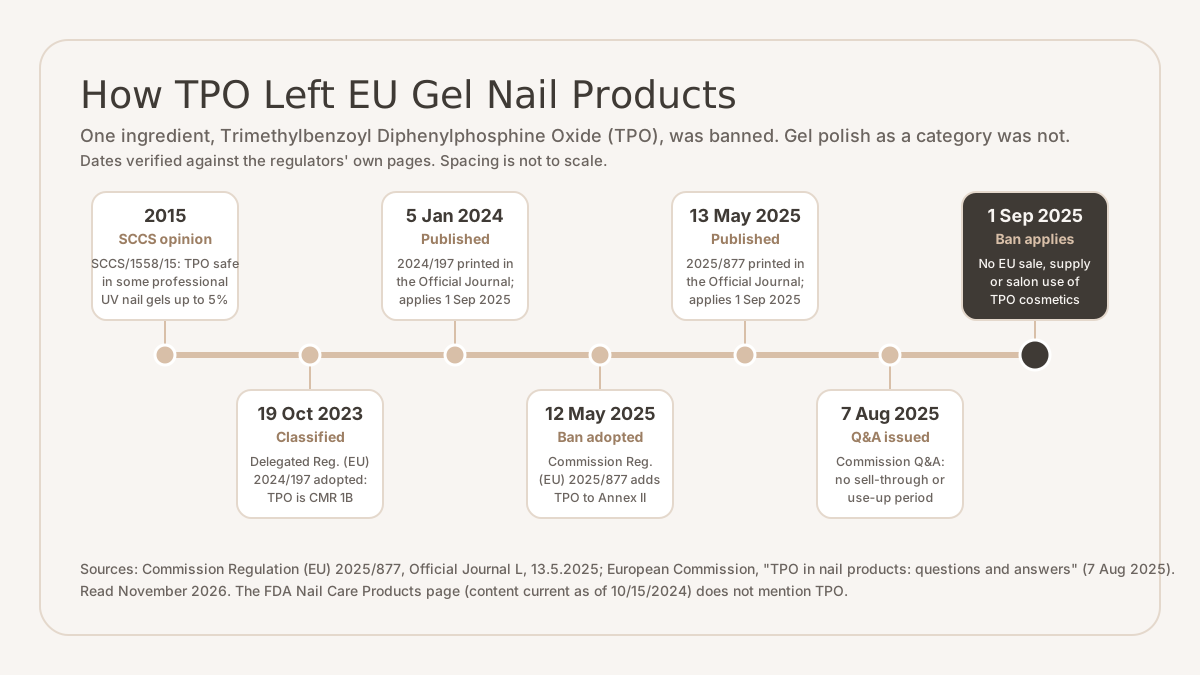
Timeline built from Commission Regulation (EU) 2025/877 (Official Journal L, 13.5.2025) and the European Commission's "TPO in nail products" Q&A dated 7 August 2025, read November 2026. Spacing is not to scale.
| Date | Step | What it did |
|---|---|---|
| 2015 | Scientific Committee on Consumer Safety (SCCS) opinion SCCS/1558/15 | Concluded TPO "was safe in certain professional UV-cured nail gels" up to 5% under specified conditions |
| Until 1 September 2025 | Annex III, entry 311, of the Cosmetics Regulation | Allowed TPO "for professional use in artificial nail systems with a maximum concentration of 5 %" |
| 19 October 2023 | Commission Delegated Regulation (EU) 2024/197 adopted | Classified TPO as a CMR substance under the EU's chemical classification law |
| 5 January 2024 | Delegated Regulation 2024/197 published | Set the classification to apply from 1 September 2025 |
| 12 May 2025 | Commission Regulation (EU) 2025/877 adopted | Moved TPO from the allowed list (Annex III) to the prohibited list (Annex II, entry 1731) |
| 13 May 2025 | 2025/877 published in the Official Journal | Set its application date as 1 September 2025 |
| 7 August 2025 | European Commission publishes its TPO Q&A | Confirmed there is no sell-through or use-up period |
| 1 September 2025 | Ban applies | TPO cosmetics can no longer be placed on, or made available on, the EU market |
Sources: Regulation (EU) 2025/877, recitals 4 to 7, Article 2 and Annex; European Commission TPO Q&A. Both read November 2026.
The exact identity of the banned substance
The regulation names the substance three ways. These are the strings to look for, and they are worth copying exactly:
- Chemical name: diphenyl(2,4,6-trimethylbenzoyl)phosphine oxide
- INCI name (the name used on cosmetic ingredient lists): Trimethylbenzoyl Diphenylphosphine Oxide
- CAS number: 75980-60-8 (EC number 278-355-8)
"TPO" is the short name used in the Commission's Q&A and across the nail industry; it does not appear in the Annex entry itself.
TPO was not the only substance on the list
Regulation 2025/877 adds 21 new entries (numbers 1731 to 1751) to the prohibited list. Most are pesticides and industrial chemicals with no link to nails. One that nail shoppers sometimes ask about is entry 1745, N,N-dimethyl-p-toluidine (CAS 99-97-8). It is on the same list and banned from the same date. Neither the regulation nor the Commission's Q&A says which cosmetic products used it, so this page does not claim it was a gel ingredient. The Q&A itself is only about TPO.
Why the EU Banned TPO: The CMR 1B Rule
The short answer to "why is gel polish banned in Europe" is that EU cosmetics law bans a substance automatically once it is classified as a CMR, and TPO was classified as one.
CMR stands for carcinogenic, mutagenic or toxic for reproduction. The regulation explains that substances are put in category 1A, 1B or 2 "depending on the level of evidence of their CMR properties", and that Article 15 of the Cosmetics Regulation provides that CMR substances "are to be prohibited from use in cosmetic products" unless specific exception conditions are met. TPO's classification is category 1B, Toxic for Reproduction. The regulation does not classify it as a carcinogen, and this page does not repeat claims about cancer that the regulator does not make.
The Commission's Q&A adds the history. The 2015 SCCS opinion that had allowed TPO in professional nail gels "predates the new CMR classification, that upgraded the classification from Cat.2 to Cat.1." Under the rules, an older safety opinion no longer applies once the stricter classification is adopted, unless someone requests an exception and a new SCCS assessment is done. According to the regulation, "No request for use in cosmetic products by way of exception has been submitted" for these substances. With no exception requested, the ban followed.
The argument that cured gel is safe
A common objection is that TPO is locked into the hardened gel once it cures, so the wearer is not exposed. The Commission's Q&A has a question on exactly this ("What if TPO is fully polymerised in the nail gel and does not pose exposure risk?"). Its answer does not treat full curing as a reason to exempt the product; it points back to the exception route, which needs a new SCCS assessment. In other words, the argument would have to be made through that formal process, and as of the Q&A it had not been.
Why there was no grace period
Many people expected salons to be allowed to use up old stock. The Q&A is direct: "The Cosmetics Regulation does not contain a 'sell-through' or 'use-up' provision for CMR category 1A or 1B substances." It contrasts this with the EU microplastics (glitter) restriction, which had long transition periods because it was made under a different law (REACH) that allows economic factors to be weighed. The Commission also reports the vote on the measure: 25 Member States in favour, 1 against, 1 abstention.
What It Means If You Buy Gel Polish in the US
For a US shopper reading about gel nail polish banned in Europe, nothing changed in law on 1 September 2025. The EU regulation applies to products placed on the EU market; it does not regulate what is sold in the United States.
The FDA's Nail Care Products page (content current as of 10/15/2024, read November 2026) does not mention TPO or any restriction on gel nail ingredients. It does say three things every gel user should know:
- Nail products "do not need FDA approval before they go on the market." Cosmetics are regulated by the FDA, not approved by it, so "FDA approved" on a gel bottle is not a meaningful claim.
- For artificial nail products, "traces of the reactive monomers could result in an adverse reaction," and "It is important to avoid contact with the skin in order to minimize the chance of an allergic reaction."
- "If you have a reaction to a nail product, please report it to FDA."
So a US bottle can legally contain TPO, and nothing on the FDA page tells you whether a given product does. The only way to know is the ingredient list or the manufacturer's own statement. Some brands now sell labelled alternatives: Beetles' own US store lists several builder gels with "HEMA & TPO-Free" in the product title (for example its Sheer Nude and Muted Nude builder gels, read November 2026), alongside other Beetles builder gel listings whose titles make no TPO claim at all. That mix is the practical lesson: a brand selling some TPO-free products tells you nothing about the specific bottle in your basket. Read that bottle's listing.
Should a US buyer avoid TPO anyway?
That is a personal decision this page will not make for you. What the sources support is this: the EU classified TPO as toxic for reproduction (category 1B) and banned it in cosmetics; the FDA's nail page does not address it. If you would rather avoid it, the checklist below shows how. If you are more concerned about allergy, the bigger everyday issue with gel is skin contact with uncured product, which is what the FDA's own wording warns about, and which the site's is builder gel bad for your nails guide covers in depth.
How to Check a Label for TPO: A Checklist
You do not need a chemistry background to check a bottle. Work through these steps in order and stop as soon as you have an answer.
- Find the full ingredient list. On a bottle it is usually on the box or a peel-back label. Online, check the listing's ingredients section or the brand's own product page, not a reseller's summary. If no ingredient list exists anywhere, you cannot confirm the product is TPO-free.
- Search for the INCI name. Look for "Trimethylbenzoyl Diphenylphosphine Oxide". On a phone, use the browser's find-in-page for "Trimethylbenzoyl" so a long list does not hide it.
- Search for the chemical name and CAS number if the brand publishes a safety data sheet: "diphenyl(2,4,6-trimethylbenzoyl)phosphine oxide" or "75980-60-8".
- Look for the abbreviation "TPO". Some lists and marketing copy use only the short form.
- Read a "TPO-free" claim as the brand's own statement. It is useful, and it is the brand's responsibility, but it is a claim, not an ingredient list. Where both exist, the ingredient list wins.
- Check every product in the system, not just the colour. Base coat, builder gel, top coat and any rubber base are separate formulas. A TPO-free colour over a base that lists TPO still puts TPO on your nails.
- Note the buying region. Products placed on the EU market since 1 September 2025 must not contain TPO. Products sold only in the US are not bound by that rule, so a brand's EU and US versions can differ.
- Keep a record. A photo of the ingredient list of each bottle you own saves repeating this every time you reorder.
Reading the result
| What the label shows | What it means |
|---|---|
| "Trimethylbenzoyl Diphenylphosphine Oxide" in the ingredients | Contains TPO. Prohibited for EU sale and salon use since 1 September 2025; legal to sell in the US |
| "TPO-free" claim and a full ingredient list without the INCI name | Consistent with being TPO-free, on the brand's own word |
| "TPO-free" claim, no ingredient list anywhere | Rely on the brand's statement only; you cannot check it yourself |
| No claim, no ingredient list | Unknown. Contact the brand or choose a product that publishes its ingredients |
Interpretation of the INCI and CAS identifiers in Regulation (EU) 2025/877, Annex II entry 1731, read November 2026.
What the Ban Means for Builder Gel
Builder gel is caught by the same rule as gel polish, because the ban is about the ingredient, not the product type. Before September 2025, TPO's legal use in the EU was specifically "professional use in artificial nail systems" (Annex III, entry 311), and builder gel, hard gel and extension gels are artificial nail systems. That entry has now been deleted.
Four practical points follow for anyone doing builder gel nails at home:
- Your existing pots are not suddenly dangerous by a new US rule. No US rule changed. The question is only whether you want to keep using a product that may contain TPO, and the label check above answers what is in it.
- Reformulated bottles can cure differently. When a brand changes a formula, its printed cure time can change too. Follow the time on the bottle you have, and see the site's how long to cure builder gel guide for why lamp and formula both matter. If a new bottle stays soft or tacky where the old one did not, the builder gel not curing page walks through the causes.
- Match the whole system. If avoiding TPO is the goal, check the base and top coat too; the best top coat for builder gel guide lists what each listing does and does not disclose.
- TPO-free and HEMA-free are different claims. HEMA is a separate ingredient discussed mainly for allergy. A product can be one without the other, so look for each on the label.
Read next
Best HEMA-Free Builder Gel in 2026: Safe Picks for Sensitive Users
HEMA-free builder gels are more limited than you'd hope, but the right options exist. Three picks for sensitivity-aware users, plus what to actually look for on the ingredient label.
Continue readingFrequently Asked Questions
Is gel nail polish banned in Europe?
No. One ingredient, Trimethylbenzoyl Diphenylphosphine Oxide (TPO), is banned from cosmetics in the EU from 1 September 2025 under Regulation (EU) 2025/877. Gel polish made without TPO can still be sold and used.
Why is gel polish banned in Europe?
It is not; TPO is. TPO was classified as a CMR substance, category 1B (Toxic for Reproduction), by Delegated Regulation (EU) 2024/197. EU cosmetics law then requires CMR substances to be prohibited unless an exception is requested and assessed, and the regulation records that no exception was requested.
Is TPO banned in the US?
The FDA's Nail Care Products page (content current as of 10/15/2024) does not mention TPO, and this page has found no FDA ban on it. Gel containing TPO can be sold in the US.
Can salons in Europe use up their old TPO stock?
No. The Commission's Q&A says a professional user "cannot use such a product on clients from 1 September 2025 onwards," even if it was bought earlier, and there is no sell-through or use-up period for CMR 1A or 1B substances.
Does the ban apply to gel I already own at home in the EU?
The Commission's Q&A does not address private use. It covers placing products on the market, supplying them commercially and using them professionally on clients.
What name do I look for on the label?
The INCI name "Trimethylbenzoyl Diphenylphosphine Oxide". Safety data sheets may use the chemical name diphenyl(2,4,6-trimethylbenzoyl)phosphine oxide or the CAS number 75980-60-8.
Does "TPO-free" gel polish exist?
Yes. Some brands label products that way; Beetles, for example, lists gel polish sets and builder gels titled "HEMA & TPO-Free" on its own store. The claim applies to the specific product named, not to the whole brand.
Will the EU rules change?
The Commission's Q&A says a proposal to revise the Cosmetics Regulation has been tabled, and that the current law applies until the European Parliament and Council endorse it. It does not say the TPO ban will be lifted.
Last updated November 2026. This article is researched with AI assistance and edited before publication; it draws on manufacturer instructions and the sources cited on this page.