Picture two bottles on a shelf: one dries in the air in a few minutes and comes off with the remover already in the bathroom cabinet, the other needs a lamp to set and an acetone soak to remove, but is sold on weeks of wear instead of days. That is the whole choice in gel nail polish vs regular polish. Regular polish is cheaper to start, gentler to remove and easy to change; gel polish lasts longer but adds a lamp, UV exposure and a harder removal, which is why dermatologists suggest taking breaks from it.
Below: the two side by side on six points, what the American Academy of Dermatology (AAD) advises, and where builder gel fits for people who want strength rather than colour.
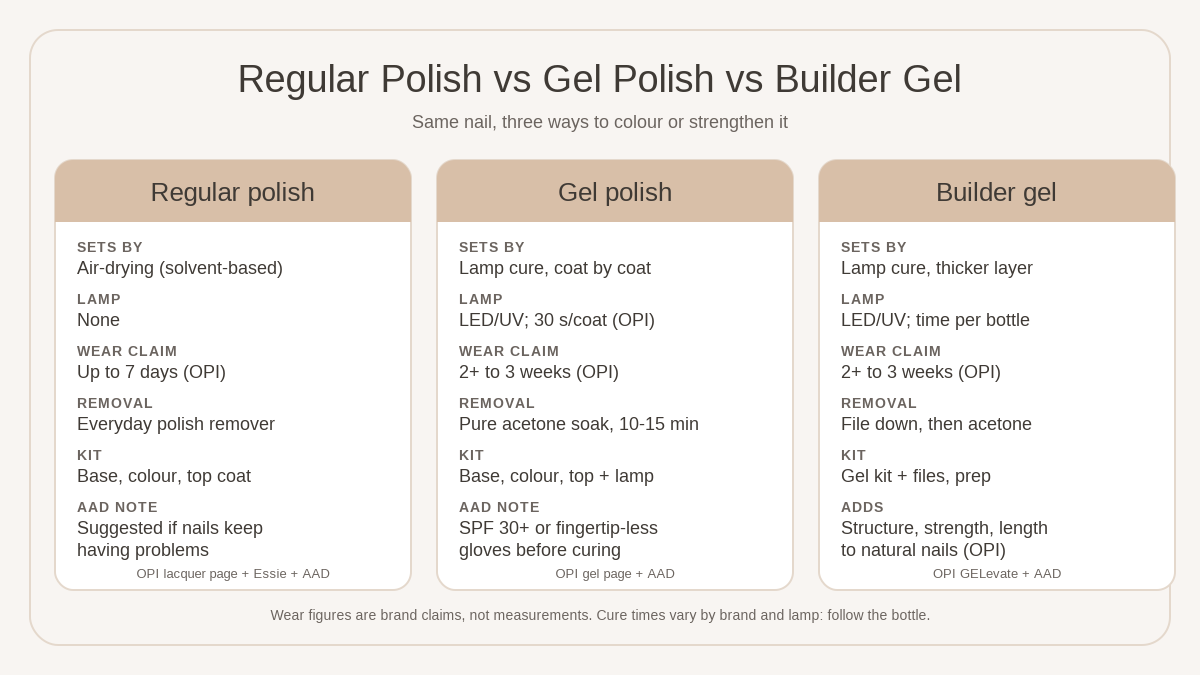
Comparison built from OPI's nail lacquer and gel pages, Essie's gel removal guide and the American Academy of Dermatology's gel manicure guidance, read November 2026. Wear figures are OPI's own claims for its products, not measurements.
The Verdict Table
Every row traces to a named source; where a figure is a brand's claim about its own product, the table says so.
| Regular polish (nail lacquer) | Gel polish | Builder gel (third option) | |
|---|---|---|---|
| Cure | Air-dries. OPI describes its lacquer as "a solvent-based, pigmented formula" that "dries on its own—no lamp, no curing" | Cured under a lamp after every coat. OPI states 30 seconds under its LED light per coat for its gel; other brands print their own times | Also lamp-cured, in a thicker layer; the cure time is whatever the bottle prints for your lamp type |
| Wear | OPI claims "up to 7 days" with its base and top coat | OPI claims 3 weeks for its salon GelColor and 2+ weeks for its at-home GELement system | OPI claims 3 weeks for its clear GELevate builder gel, 2+ weeks for colours |
| Removal | Ordinary nail polish remover | Pure acetone soak: the AAD's home method is 10 minutes under plastic wrap; its salon guidance says about 15 minutes. Essie says to use "pure acetone, not your everyday nail polish remover" | File the bulk down, then soak; more material to remove than gel polish |
| Tools | Base coat, colour, top coat | Gel base, gel colour, gel top coat, a UV/LED lamp, plus acetone, cotton and wrap for removal | Everything for gel polish, plus files and nail prep |
| Nail-health notes | The AAD suggests considering regular polish instead of gel if you have recurring nail problems or are allergic to acetone | The AAD says gel manicures "can be tough on nails" and that repeated UV exposure raises skin-cancer and premature-ageing risk on the hands | Same UV and acetone points as gel; OPI notes builder gel "cannot bond to skin" and lifts if it touches the cuticle |
| Best for | Frequent colour changes, short events, nails recovering from gel | A long-lasting colour for a trip or occasion | Adding strength or a little length to natural nails |
Choose gel polish if
- You want colour that lasts past the one-week mark OPI quotes for its own lacquer, for a holiday, a wedding or a stretch of busy weeks.
- You are willing to own (or pay a salon to use) a UV/LED lamp and to apply sunscreen or fingertip-less gloves before every cure.
- You can commit to removing it properly with an acetone soak, never by picking or peeling.
- Your nails are currently healthy, with no recurring splitting, peeling or problems around the cuticle.
Choose regular polish if
- You like to change colour every few days, or only want polish for a single event.
- Your nails are brittle, peeling or recovering from a run of gel manicures, which is exactly when the AAD recommends a break.
- You are allergic to acetone, or simply do not want a lamp or an acetone soak in your routine.
- You want the lowest cost of entry: three bottles and no equipment.
If neither list fits because your real goal is stronger nails rather than longer-lasting colour, skip ahead to the builder gel section.
How Each One Sets: Air-Dry vs Lamp Cure
The single biggest difference sits in the chemistry of drying. Regular nail polish is a coating dissolved in solvent. As OPI puts it on its nail lacquer explainer, lacquer is "a solvent-based, pigmented formula that's applied with a brush" and it "dries on its own." The solvent evaporates, the film hardens, and nothing else is needed. OPI's recommended routine is one coat of base, two thin colour coats "allowing each coat to dry in between", then one top coat.
Gel polish does not dry in the air at all. It stays wet until it is cured under ultraviolet or LED light, and it is applied in separate layers, each cured before the next. OPI's gel explainer describes a gel manicure as "typically applied in three separate parts" (base, gel colour and top coat) and says nails "are cured under an LED light for 30 seconds after each coat is applied." That 30-second figure is OPI's, for OPI gel under OPI's own lamp. Cure times are set per brand and per lamp, so the bottle in your hand is the only reliable instruction. The site's guide to the best UV lamp for builder gel explains how to read lamp listings, and the same lamps cure gel polish.
Two practical consequences follow:
- Waiting time. Regular polish needs time between coats for the solvent to leave, which is why OPI tells you to let each coat dry before the next. Gel moves on to the next layer as soon as the lamp time printed on the bottle is up.
- They are separate systems. Because one relies on evaporation and the other on curing, a lamp does nothing useful for lacquer, and gel colour left out of the lamp never sets. Do not mix layers from the two systems unless the brand says its products are designed to work together.
Wear and Removal, Side by Side
In gel nail polish vs regular polish, wear time is where gel wins and removal is where it costs you.
Wear. Treat every wear figure as a claim, not a measurement. OPI says its lacquer gives "up to 7 days of wear" when used with its base and top coat, while its gel lines are sold on "3 weeks of durable wear" (GelColor, salon) and "2+ weeks of glossy wear" (GELement, at home). Other brands make their own claims, and nobody independent publishes an average for either category.
Removal of regular polish. A cotton pad and ordinary polish remover. It takes moments, needs no soaking, and can be repeated every few days.
Removal of gel polish. Gel needs acetone, and time. Essie, on its gel removal guide, is blunt: it is "paramount to use pure acetone, not your everyday nail polish remover." The AAD's home removal guide, written with dermatologist Shari Lipner, MD, PhD, sets out the method:
- Coat the cuticles and the skin around each nail with petroleum jelly to protect it from acetone.
- Cut cotton to the size of each nail and soak it in 100% acetone.
- Place it on the nail and wrap with plastic food wrap, snug but not tight enough to cut off circulation. The AAD prefers wrap to foil because foil is more likely to let acetone drip.
- Leave it for 10 minutes, then rub the softened polish away with a washcloth dampened in warm water.
- Wash with gentle soap and water, and rub petroleum jelly into the cuticles and surrounding skin daily for seven days.
The AAD also lists what not to do: do not use an orange stick, which "can injure your nails and cause white spots", and do not pick or file the gel off, which can significantly damage nails. OPI's own salon steps add a light file of the top coat first to "break the seal", then a 15 to 20 minute soak.
If you would rather not remove gel at all, the AAD's alternative is to let it grow out: clip the nails weekly and resist picking. That is slow, because fingernails take about six months to grow out fully.
Is Gel Nail Polish Bad for Your Nails? What the AAD Says
Short answer: it can be hard on nails, so dermatologists treat gel as something to do occasionally and carefully, not continuously. The AAD's overview of manicures and pedicures puts it in one line: "Although gel manicures can be beautiful and long-lasting, they can be tough on nails." Its dedicated page on gel manicures lists brittleness, peeling and cracking as the effects, and goes further on UV: repeated use of the lamps can raise the risk of skin cancer and premature ageing on the hands.
The AAD's practical advice, condensed:
- Protect your hands from the lamp. Apply a broad-spectrum, water-resistant sunscreen with SPF 30 or higher before curing, or wear dark, opaque gloves with the fingertips cut off.
- Leave cuticles alone. Do not let anyone push or cut them; the AAD links that to inflammation and infection.
- Do not pick. Chipped gel should be removed properly, not peeled.
- Take breaks. Go without polish for one to two weeks or longer between gel manicures so the nails can repair, and apply a moisturizer such as petroleum jelly to nails and cuticles several times a day.
- Save it for occasions. The AAD's own suggestion is to keep gel manicures for special occasions.
- Know when to switch. If you have recurring nail problems, or are allergic to the acetone that gel removal requires, the AAD suggests regular polish instead.
- See a board-certified dermatologist if you notice unusual nail changes or a nail problem that will not go away.
Regular polish is not ingredient-free either. The US Food and Drug Administration's nail care products page notes that some nail polishes have contained toluene, formaldehyde-based resin or dibutyl phthalate, and that nail products in general "do not need FDA approval before they go on the market", with the exception of most colour additives. It also advises avoiding skin contact with nail products "to minimize the chance of an allergic reaction", and asks consumers to report any reaction to the FDA. In practice that means wiping any gel off the cuticle area and side walls before the hand goes under the lamp.
For a fuller, two-sided look at the thicker product, the site's guide on whether builder gel is bad for your nails covers filing damage, sensitisation and breaks in detail.
Cost of Entry, and Where Builder Gel Fits
This page does not quote prices, because they change daily and vary by brand, but the shopping list itself shows the gap.
Regular polish: a base coat, a colour and a top coat. Add a bottle of remover and some cotton. Nothing plugs in.
Gel polish at home: a gel base coat, gel colour and gel top coat that are designed to be cured, plus a UV/LED lamp. OPI's at-home GELement system, for example, is sold as a kit that "includes a 4-finger LED Gel Lamp, base and top coat". Removal adds 100% acetone, cotton, plastic wrap and petroleum jelly, and a sunscreen or fingertip-less gloves for each session. The lamp is the one-off cost; everything else is consumable. The site's roundup of the best gel nail kit options compares bundles that include the lamp.
Builder gel: the third option. Both gel polish and regular polish are colour coats: thin films that sit on the nail and add very little strength. Builder gel is a different job. OPI defines it as "an enhancement product used to add structure, strength, and length to natural nails." It is cured with the same lamp as gel polish, so anyone who already owns a gel setup is most of the way there, but it goes on thicker, is shaped into an arch for strength, and needs files and careful prep. Two points from the comparison matter here:
- The skin rule is stricter. OPI notes that builder gel "cannot bond to skin" and will lift if it touches the cuticle, so clean application matters even more than with gel colour.
- Removal is longer. There is more product on the nail, so most of it is filed down before soaking. The builder gel removal guide covers that file-then-soak routine.
Shop listings muddle the names ("builder gel polish", "builder in a bottle"); the explainer on builder gel nail polish untangles them.
The short version of gel nail polish vs regular polish, with builder gel added: regular polish for colour you change often, gel polish for colour that has to last, builder gel when the nail itself needs support. The builder gel nails homepage links every guide on the site if the third column is the one you are leaning towards.
Read next
How to Remove Builder Gel at Home Safely: 3 Methods Compared (2026)
Three methods to remove builder gel — file-and-soak, file-only, and salon e-file — compared on time, safety, and nail-health impact. Plus a detailed step-by-step for the safest at-home method.
Continue readingFrequently Asked Questions
Can you put a lamp over regular nail polish to make it dry faster?
No. Regular polish dries by evaporation, not curing; OPI says its lacquer dries "on its own—no lamp, no curing". A lamp only adds UV exposure for no benefit.
Is gel nail polish bad for your nails?
It can be hard on them, which is the AAD's own wording: gel manicures "can be tough on nails", with brittleness, peeling and cracking as the effects, and repeated UV exposure as a skin concern. Following the AAD's advice (sunscreen or gloves before curing, no cuticle cutting, proper acetone removal and breaks of one to two weeks or longer) reduces the risk.
Can you take gel polish off with regular nail polish remover?
Essie says no: use "pure acetone, not your everyday nail polish remover." The AAD's home method uses 100% acetone on cotton, wrapped for 10 minutes.
How long does gel polish last compared with regular polish?
By OPI's own claims for its products, its lacquer lasts "up to 7 days" with base and top coat, and its gel lines are sold on 2+ to 3 weeks of wear. Other brands make different claims and there is no independent average, so treat these as upper-end promises rather than guarantees.
Is builder gel the same as gel polish?
No. Both cure under the same lamp, but gel polish is a thin colour coat, while builder gel is a thicker enhancement product that OPI describes as adding "structure, strength, and length to natural nails." It takes longer to apply and to remove.
Last updated November 2026. This article is researched with AI assistance and edited before publication; it draws on manufacturer instructions and the sources cited on this page.