Why Nail Forms Matter
Editor Picks — Amazon
Top picks for nail forms for builder gel
Curated from current Amazon ratings and review counts.

Teenitor Nail File Nail Buffer, 6 pcs Nail Files and Buffers for Natural Nails, Emery Boards for Nails, Nail Buffer and Shine Kit Nail Filer, Nail Buffer Block 100/180 Grit Nail Files Fingernail Files
$6.99
Amazon price as of Sep 18, 2026

modelones Builder Nail Gel, 7-in-One Clear Builder for Nails, LED Lamp Cured Color Rubber Base Gel Polish Coat Strengthener Thickening Extension Rhinestone Glue in a Bottle for DIY Home Salon Gifts
$8.49
Amazon price as of Sep 18, 2026

Saviland Long Length Reusable Nail Forms: Super Sticky Duable Poly Gel Nail Forms Sturdy Nail Extension Forms Paper Nail Forms Self-adhesive Nail Model Stencils for Acrylic Nails Builder Nail Gel
$7.19
Amazon price as of Sep 18, 2026

Orly Builder In A Bottle Soak-Off Sculpting Gel For Quick Nail Extension, Repair And Strengthening | Long-Lasting Builder Gel With Brush-On Application | Salon-Quality Nails At Home (18ml)
$17.94
Amazon price as of Sep 18, 2026
Scroll →
Product prices and availability are accurate as of Sep 18, 2026 and are subject to change.
Nail forms for builder gel are the temporary scaffold you place under the natural nail to give builder gel something to extend onto. Without a form, builder gel has nothing to grab past the free edge — you can't add length.
Nail forms for builder gel come in three types, and beginners should start with only one of them. Three types dominate the 2026 market:
- Paper forms — disposable, single-use, sticker-style
- Dual forms — reusable plastic clamshells that build the nail upside-down
- Tip forms (Gel-X tips) — pre-shaped tips that stay on the nail (not removed)
Each has a different application workflow and a different result. This guide explains when each one fits.
If you're new to extensions entirely, start with how to use builder gel for the application basics first.
Type 1 — Paper Nail Forms
What they are: Sticker-style paper forms that adhere under the free edge. You apply the builder gel onto the form, cure, then remove the paper.
Application:
- Size the form to your nail
- Stick it under the free edge, leaving a small gap
- Build builder gel from the natural nail onto the form
- Cure
- Refine and remove the form
Best for:
- Custom shapes — you can extend in any direction
- Beginners learning sculpting (more forgiving than dual forms)
- Custom apex placement
- Long-form sculpting work
Where they fall short:
- Single-use (cost adds up over many sets)
- Tricky to position on non-dominant hand
- Need to refile underside after removal
Paper forms are what most pro techs use for sculpted extensions. Olive & June's Builder Gel Kit includes paper forms. Beetles and Modelones kits also include them.
Type 2 — Dual Nail Forms
What they are: Reusable plastic clamshells. You place builder gel into the form (which has a pre-shaped nail cavity), press the form onto your finger, cure, then snap the form off.
Application:
- Place builder gel into the dual form cavity
- Press the form onto your prepped natural nail
- Cure 60-90 seconds
- Snap or twist the form off
- Refine
Best for:
- Speed — much faster than paper forms once you're proficient
- Consistent shape across all 10 nails
- Nail-tech salon work where time matters
- Reusability — wash and reuse 50+ times
Where they fall short:
- Sizes are pre-set (your nail might not match perfectly)
- Less customization of shape
- Initial learning curve to position correctly
- Can trap product if technique is off
Dual forms are popular with pros who do high-volume client work. They're not in many beginner kits — usually a separate purchase ($15-$25 for a multi-size set).
Type 3 — Tip Forms (Soft-Gel Tips)
What they are: Pre-shaped soft-gel tips (most commonly Aprés Gel-X). You glue them on with builder gel or extend gel and they stay on permanently as part of the set.
Application:
- Size each tip to the nail
- Apply a thin layer of builder gel or extend gel to the natural nail
- Adhere the tip
- Cure 60s
- Refine length and shape
Best for:
- Standardized shapes (almond, square, oval) at consistent lengths
- Speed — full set in 30-45 minutes
- Beginners who don't want to learn sculpting
- Salon services with predictable tip inventory
Where they fall short:
- Custom shapes not possible (you're limited to tip molds)
- Tip sizes may not fit unusual nail beds
- Removal is more involved than custom-built sets
- Higher cost over time (replacement tips add up)
For full Gel-X comparison, see builder gel vs Gel-X.
Read next
Builder Gel vs Gel-X in 2026: 6 Use Cases Where One Beats the Other
Builder gel vs Gel-X — six use cases where one clearly beats the other, plus the cost-per-year math, removal trade-offs, and when to use both together.
Continue readingWhich Forms Should Beginners Start With?
Recommendation: Start with paper forms.
Reasons:
- They're forgiving — you can wipe off mistakes before cure
- Most beginner kits include them (no extra purchase)
- They teach you sculpting fundamentals (apex placement, shape control)
- Skills transfer to dual forms later if you upgrade
Avoid dual forms for your first 5-10 sets. The shape positioning is unforgiving. Start with paper, build the apex skill, then upgrade.
How to Use Paper Forms — Step by Step
The process for paper-form sculpted extensions:
Step 1 — Size the Form
Hold the form against the free edge of your natural nail. The cuticle-side of the form should curve to match the C-curve of your natural nail.
Step 2 — Stick the Form
Peel the form's adhesive backing. Stick the form under the free edge, leaving a 0.5-1mm gap between the form and the natural nail. The form should be slightly tucked under, not flush.
Step 3 — Apply Builder Gel
Pick up a bead and place it from the natural nail onto the form, blending where the natural nail meets the form. Build the apex over the stress point (1/3 back from new free edge).
Step 4 — Build the Length
Extend the gel out onto the form. Don't go to the very tip of the form — leave 1-2mm of form visible past the gel.
Step 5 — Cure
60-90 seconds LED, depending on bead thickness. Thumbs need 90+ seconds.
Step 6 — Remove the Form
Once fully cured, peel the paper form off carefully. The cured gel keeps its shape.
Step 7 — Refine
File the underside of the free edge to smooth it. File the top to refine apex shape. Top coat.
For complete builder gel application context, see how to use builder gel.
Read next
How to Use Builder Gel: Salon-Tested 8-Step Application for Beginners (2026)
The exact 8-step builder gel routine I use on clients — prep, base, slip layer, apex placement, cure, refine, top coat, finish. With timing, common mistakes, and per-step troubleshooting.
Continue readingCommon Form-Related Issues
| Issue | Cause | Fix |
|---|---|---|
| Form won't stick | Cuticle-side has oil residue | Wipe with alcohol before sticking |
| Gel flows under the form | Form positioned too far down | Slide closer to free edge before sticking |
| Form bends during cure | Too much pressure when sticking | Lighter touch, let adhesive grab |
| Underside of free edge is rough | Need to refile after form removal | 220-grit file under the free edge |
| Length is uneven across nails | Form sizes not matched per nail | Size each form individually before sticking |
Forms Included in Popular Kits
Most builder gel kits ship with at least basic paper forms. Some specifics:
- Olive & June Builder Gel Kit — paper forms included, sized for typical nail beds
- Beetles 8-in-1 Kits — paper forms in most bundles
- Modelones Kit — paper forms in starter bundles
- Makartt Clear Gel Builder Kit — includes both paper forms AND dual forms
- Aprés Gel-X Signature Kit — includes Gel-X tips (the form IS the tip)
For specific kit recommendations including form contents, see best builder gel kits.
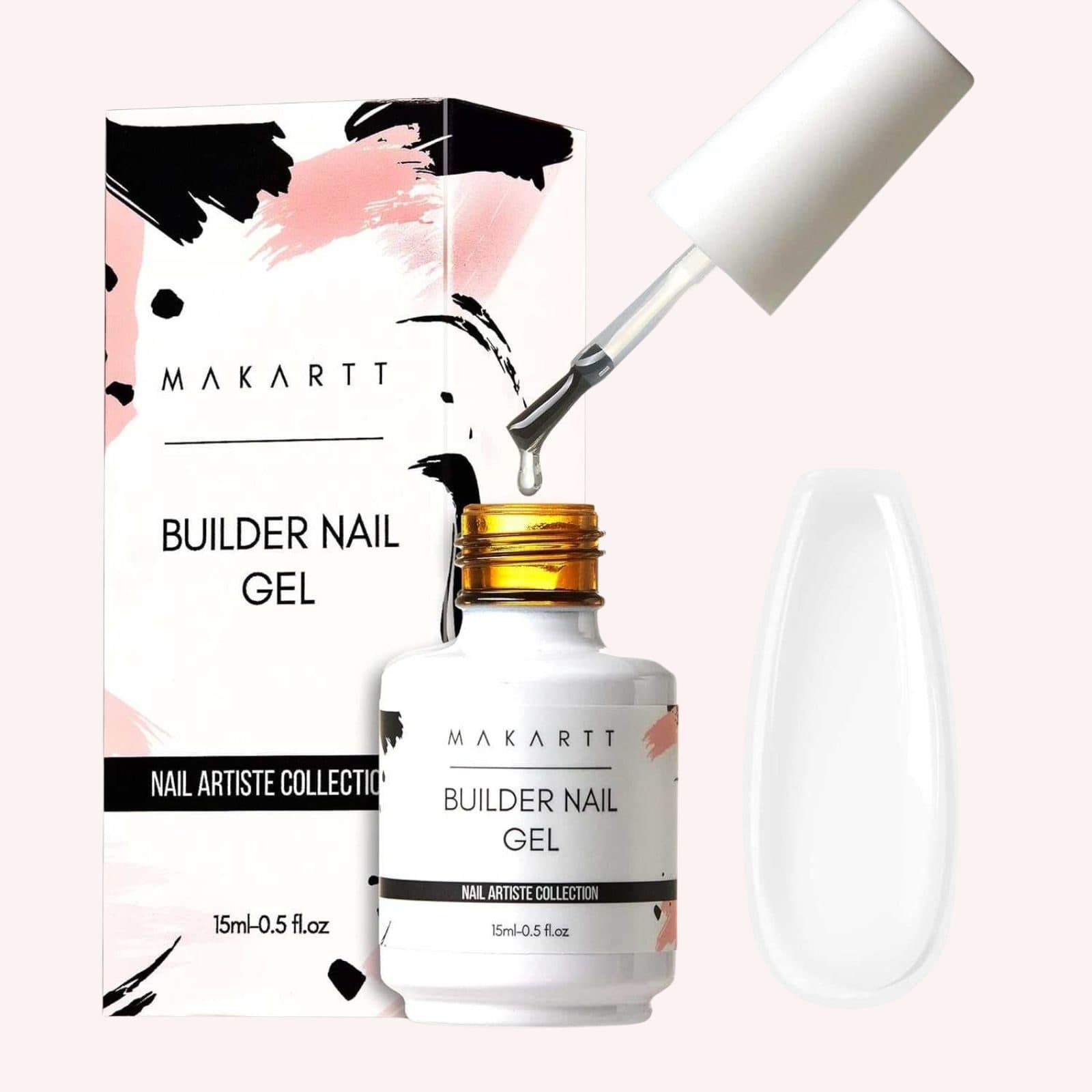
Makartt Clear Gel Builder Kit
$9.99
Amazon price as of Sep 18, 2026
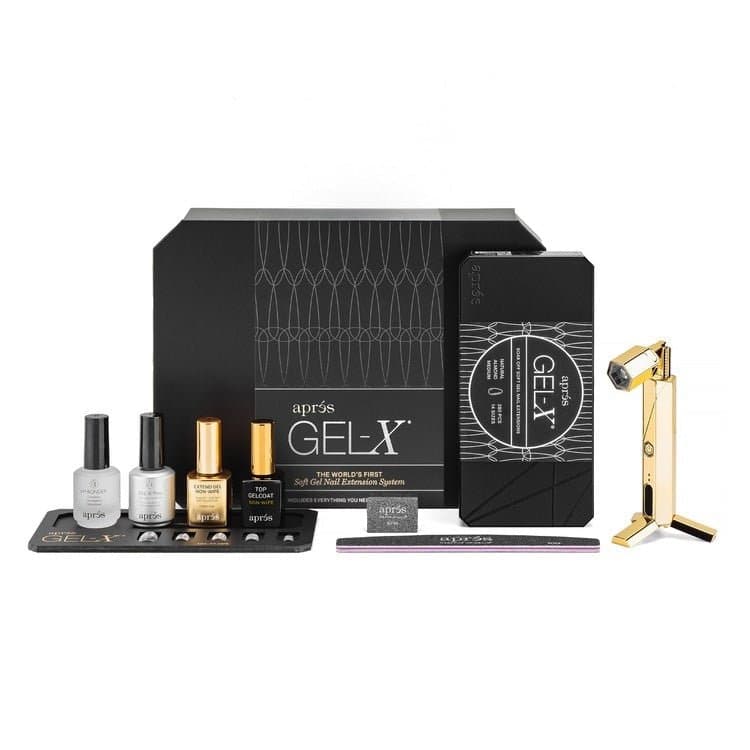
Aprés Gel-X Signature Kit
$50–$120
Also on Amazon
Beetles Hard Gel for Nails Kit (3 Colors)
$29.99★ 4.4
Are Forms Necessary for Builder Gel?
No — only for extensions. If you're doing builder gel as an overlay (no length added) on natural nails, you don't need any forms. The natural nail itself is the structure.
For natural-nail overlay technique, see builder gel on natural nails.
Read next
Builder Gel on Natural Nails: The Strengthen-and-Protect Guide (2026)
Builder gel is the gentlest enhancement option for weak, peeling, or recovering natural nails. Here's exactly when to use it, how to apply it differently than for extensions, and the recovery schedule that prevents long-term thinning.
Continue readingSizing Forms Correctly — The Hidden Skill
Form sizing is what separates good extensions from awkward ones. Generic guidance:
For paper forms:
- Hold the form against the natural nail's free edge
- The width at the cuticle side should match the natural nail's free-edge width exactly
- The C-curve of the form should match the C-curve of your natural nail
- If sizes don't match, trim the form with sharp scissors before sticking
For dual forms:
- Hold the form against your natural nail
- Look at the cuticle side of the form — it should fit edge-to-edge against your natural nail's stress point
- If too wide: form will gap at the sides; gel will leak out
- If too narrow: form will pinch the natural nail; result will be too narrow
- Most dual-form sets ship 10+ sizes; expect to use 3-5 different sizes across your 10 fingers
For Gel-X tips:
- Aprés ships 11 sizes per shape
- Match each finger individually (most users use 3-4 different sizes per hand)
- Tip should sit flush against the natural nail's free edge — no gap, no overhang
- File the tip down to your preferred shape AFTER applying
The 5-minute time investment in proper form sizing across 10 nails is the difference between a salon-quality result and a "looks DIY" result.
When Forms Damage Natural Nails
Form-related damage is rare but possible. Watch for:
Adhesive residue stuck to natural nail. Some paper forms leave sticky residue when removed. This residue can cause lifting on subsequent sets. Wipe with alcohol after every removal.
Trapped uncured monomer under the form. If the form was positioned over wet builder gel and the cure didn't penetrate fully, you have uncured gel under the form against your skin or natural nail. This is a sensitization risk. Always position the form before applying the gel, not after.
Pinching from too-tight dual forms. Some users force dual forms onto fingers that don't match the form size. This can compress the natural nail temporarily. If the form doesn't fit naturally, use a different size — don't force it.
If you're seeing any natural-nail damage, see builder gel lifting fixes for diagnostic guidance.
Frequently Asked Questions
What are nail forms for builder gel? Temporary scaffolds (paper, dual, or tip-shaped) that let you build builder gel past the natural nail's free edge to add length.
Do I need nail forms for builder gel? Only for extensions. For overlays (no length added), no forms needed.
Best nail forms for builder gel? Paper forms for beginners (most kits include them). Dual forms once proficient. Gel-X tips if you prefer pre-shaped over custom-sculpted.
Paper vs dual nail forms? Paper for custom shapes and beginner-friendly application. Dual for speed and consistency once you've practiced. Both are legitimate pro tools.
How to use nail forms for builder gel? Size, stick under the free edge, apply gel from natural nail onto form, cure, remove form, refine. Full process above.
Are nail forms reusable? Paper forms: no, single-use. Dual forms: yes, wash and reuse 50+ times.
What's better — paper forms or tips? Paper for custom shapes, tips for speed and standard shapes. Different use cases.
Best nail forms for beginners? Paper forms. More forgiving than dual forms for first-time sculpting.
Can you use builder gel without forms? Yes — for overlays on the natural nail. Forms are only for adding length.
A Note on Forms and Skin Contact
Nail forms create extra opportunity for builder gel to contact skin (around the form's adhesive edge, especially during the first cure). Skin contact with uncured monomer is the primary pathway for acrylate sensitization — the American Academy of Dermatology covers this allergy pattern. When using forms, position carefully so no gel touches skin during application, and remove any flooding immediately before cure.
Final Notes from Sara
Nail forms are the gateway from "builder gel overlay" to "builder gel extensions." Most beginners avoid forms for their first 5-10 sets — there's no rush. Once your apex placement is solid on overlays, paper forms are the next skill to learn.
If you skip forms entirely and go straight to Gel-X tips, that's a different but legitimate path. See builder gel vs Gel-X to compare.
For full application context, see how to use builder gel and the Builder Gel Nails pillar.
Last updated May 2026. This article uses AI assistance for research and structure; all techniques come from my own client work.