Yes, you can wear regular nail polish on gel nails, as long as the gel underneath is fully cured and you take the polish off with a non-acetone remover. Air-dry polish sits on top of cured gel or builder gel like it sits on a bare nail. Acetone is the catch: it strips the polish, then keeps going and starts to soften soak-off gel underneath.
That one condition shapes everything below. Painting over gel is the easy part, and it lets you change colour without removing the set. Removal is where a set gets ruined, because the remover most people keep at home may contain acetone, and acetone is the solvent soak-off gel is designed to dissolve. Young Nails, a professional nail product manufacturer, states it directly in its guide to painting regular polish over gel: "it is important to use nail polish remover, not straight acetone," because "acetone can begin to break down the gel polish underneath."
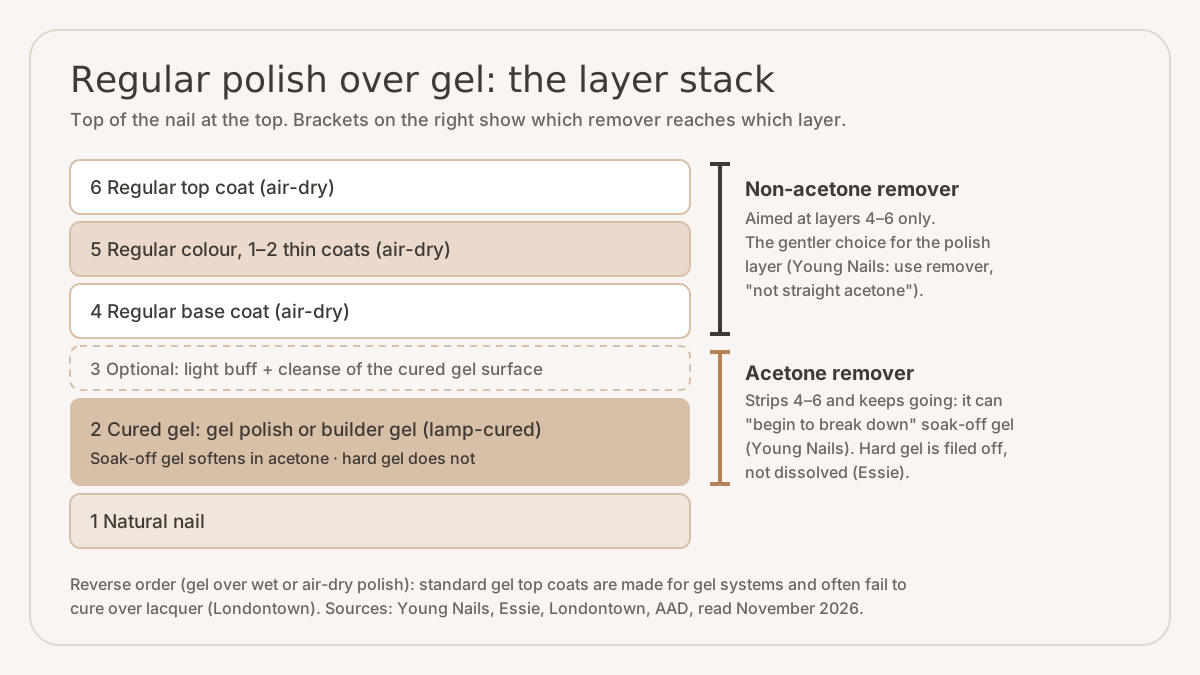
The layer stack when regular polish goes over gel, and which remover reaches which layer. Sources: Young Nails (remover choice), Essie (acetone softens soak-off gel; hard gel is filed off), Londontown (gel top coat over lacquer), read November 2026.
How to Paint Regular Polish Over Gel or Builder Gel
The method is the same whether the gel underneath is a gel polish manicure, a builder gel overlay or a set of extensions. What changes is how much the base is worth protecting: a builder gel set may be meant to stay on for weeks, so the polish layer should be easy to take off without touching it.
Step 1: Make sure the gel is fully cured
Regular polish needs a finished surface to sit on. If the gel still feels soft, or the colour smears when you touch it, it is under-cured, and painting over it only hides the problem. Fix the cure first. A gel surface that is cured but still tacky has an inhibition layer on it, which the sticky builder gel page explains; wipe that off first so the polish is not sitting on a slick film.
Step 2: Lightly buff the gel surface
Young Nails starts its method by buffing "the gel polish that is already applied to the nail." The aim is to take the high gloss off, not to remove gel. A few light passes with a fine buffer across the whole nail is enough; Essie lists a buffer of 240 grit or higher for smoothing gel in its gel removal guide, and that finer grit is the right tool here too. Avoid a coarse file, which cuts into the gel you are trying to keep.
Step 3: Cleanse off the dust
Young Nails cleanses the buffed nail with its own prep cleanser (Swipe) "for a clean, smooth surface." Any lint-free wipe with a nail cleanser does the same job: it clears buffing dust and oils so the base coat touches the gel, not a layer of residue. Wiping with an acetone-based product here is the one thing to avoid, for the same reason as at removal.
Step 4: Base coat, colour, top coat
Apply a regular base coat, then the colour, then a regular top coat. Young Nails' sequence is a base coat, "one or two even coats of color," and a top coat, and it notes that "most colors will cover in 2 coats," with a few minutes of drying between coats if a third is needed. Keep every coat thin. Gel already adds thickness to the nail, so heavy polish on top makes the nail look bulky and takes longer to dry.
Step 5: Let it air-dry, never lamp-cure it
Regular polish dries by evaporation. A UV/LED lamp does nothing useful for it. SUNUV, a nail lamp manufacturer, says in its curing FAQ that its lamps "are designed to cure gel polish only — not regular nail polish. Regular polish should air dry." Give it the same drying time you would on a bare nail.
How to Remove Regular Polish Without Damaging the Gel
The goal at removal is to dissolve the top three layers in the diagram and leave layer 2 untouched. That comes down to the remover, how long it sits on the nail and what it is used on.
Why acetone softens soak-off gel
Soak-off gel, which includes most gel polish, rubber base and most builder in a bottle, is formulated to be dissolved by acetone. Essie describes the process in its gel removal guide: filing the top surface lets "the acetone to penetrate, soften and lift away the gel." That is exactly what you want when the gel is coming off, and exactly what you do not want when only the polish on top is. Young Nails warns that acetone "can begin to break down the gel polish underneath," which is how a polish change ends with a dull, softened or lifting gel set. The soak off builder gel at home guide shows the same chemistry used on purpose.
Pick the right remover
| Remover | On soak-off gel polish | On soak-off builder gel | On hard gel | Verdict for taking regular polish off gel |
|---|---|---|---|---|
| Non-acetone remover | Removes the polish layer; the gel is the layer it is meant to leave alone (Young Nails) | Same as gel polish | Removes the polish layer | Use this one |
| Regular "everyday" remover containing acetone | Can begin to break down the gel underneath (Young Nails) | Same risk; builder gel is soak-off unless labelled hard gel | Not dissolved by acetone, per Essie; still dries skin | Avoid on soak-off gel |
| 100% (pure) acetone | Softens and lifts the gel: this is the gel removal method (Essie, AAD) | Softens it after the bulk is filed down (Essie) | "Can only be filed off" (Essie) | Only when the whole gel set is coming off |
Sources: Young Nails, "Can you paint regular polish over gel nails?"; Essie, "How to remove gel nail polish at home"; AAD, "Removing gel polish at home." Read November 2026. The table summarises their statements; it is not a lab test.
Remover labels are the only way to tell which kind you have. Read the ingredient list for acetone before you start. Essie draws the same line from the other side: to remove gel itself, "use pure acetone, not your everyday nail polish remover." Ordinary remover is therefore the weaker option against gel, which is why the non-acetone version is the safe choice for polish on top.
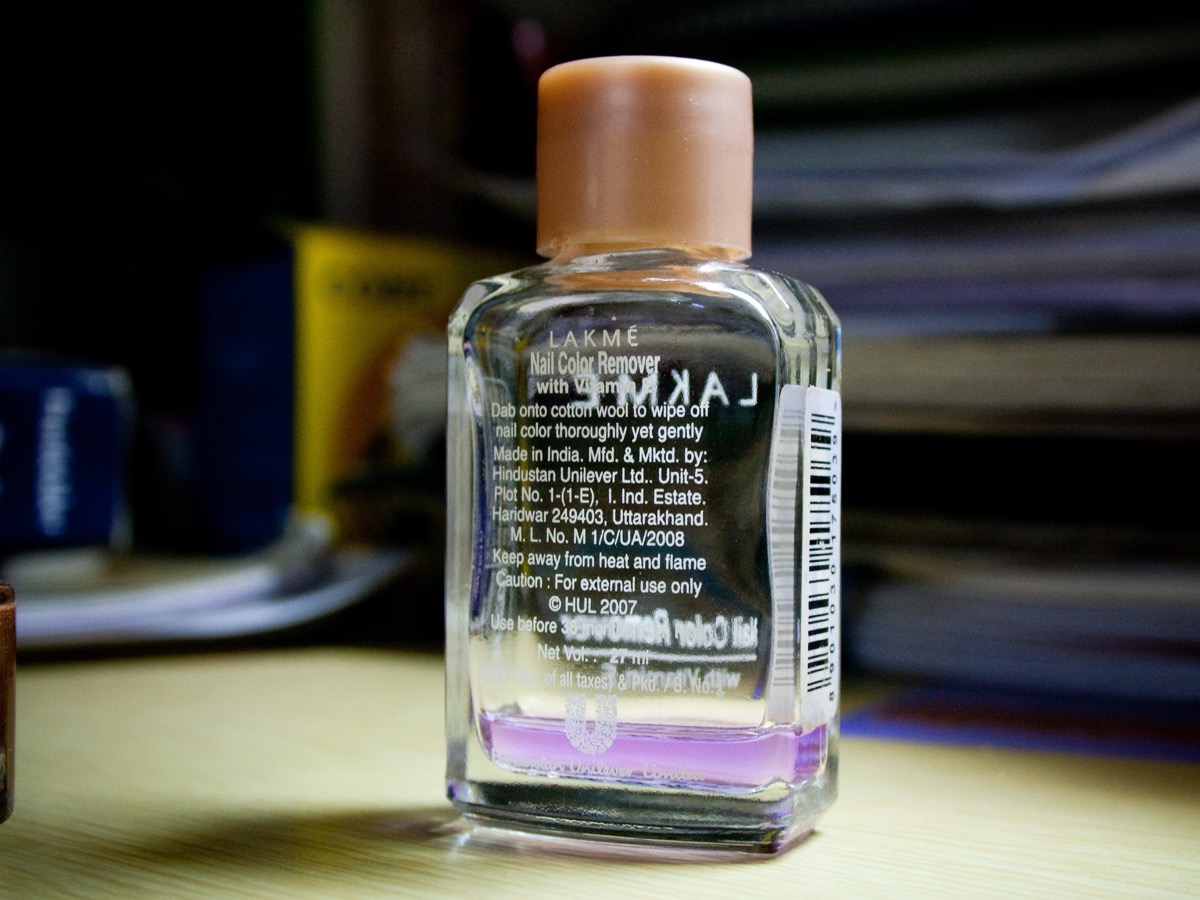
A bottle of nail colour remover. Labels differ: check the ingredient list for acetone before using any remover on a gel set, and follow the label's warnings.
The removal steps
- Work in a ventilated room. The FDA advises good ventilation when using nail products and warns that some can catch fire near a flame or heat source.
- Soak a cotton pad in non-acetone remover and press it on the nail for a few seconds so the polish softens.
- Wipe from cuticle to tip in one or two firm strokes. Turn the pad to a clean area and repeat until the colour is gone.
- Do not scrub one spot or leave a soaked pad sitting on the nail for long. The polish needs a short contact time; extra soaking only exposes the gel and the skin.
- Wash and moisturise. The American Academy of Dermatology notes that acetone left on the skin "can irritate and damage your skin", and it recommends washing off removers and rubbing petroleum jelly into the cuticles afterwards.
If acetone already touched the gel
A dull or slightly tacky surface after an acetone remover is a sign the top of the gel has started to soften. Do not pick at it or peel any lifted edge: the AAD warns that "picking and scraping off the polish can damage your nails." Wash the nail, let it dry, and look again. If the gel is lifting, treat it like any lifted set (re-sealing or replacing the lifted nail), or plan a full, proper removal.
Regular Polish on Builder Gel vs Gel Polish vs Hard Gel
The stack in the diagram is the same for every gel, but what sits in layer 2 decides how forgiving removal is.
Gel polish
A gel polish manicure is the thinnest base. It is also soak-off by design, so an acetone mistake reaches the whole colour layer quickly. Non-acetone remover only.
Builder gel
Most builder gel, including products sold as "builder gel nail polish" or builder in a bottle, is soak-off. It is thicker than gel polish, which Essie notes means more filing before acetone can remove it, but thickness does not make the surface immune to acetone. The site's builder gel nail polish page explains what these products are. The same rule applies: non-acetone remover for the polish layer.
Hard gel
True hard gel does not soak off. Essie states that "hard gels can only be filed off, preferably by a professional manicurist," and the how to remove hard gel guide covers that file-off method. So acetone remover will not dissolve a hard gel set. Non-acetone is still the better habit, though, because acetone can irritate the skin (AAD) and some products with "hard" in their name are actually soak-off; the builder gel vs hard gel comparison shows how to tell.
Gel with a no-wipe top coat
Many gel sets finish with a no-wipe top coat, which cures to a high shine. That gloss is the reason Step 2 matters: buffing gives regular polish something to grip. The site's best top coat for builder gel guide compares wipe and no-wipe top coats.
Why Gel Over Regular Polish Usually Fails
The reverse order (regular colour first, gel on top) is the question people ask next, usually to get gel shine and wear from a favourite lacquer shade. The short answer is that the usual gel top coat is the wrong product for it.
Regular polish does not cure
A lamp cures gel; it does not dry lacquer. SUNUV's FAQ is explicit that its lamps cure "gel polish only — not regular nail polish." Putting regular polish under gel means the lamp is curing a gel layer over a layer that is still drying by evaporation.
Gel top coats are made for gel systems
Londontown, a nail care brand, explains in its guide to gel top coat over regular polish that "gel top coats are formulated to work only with gel polish systems." Over lacquer, it says, they often fail to cure properly, which shows up as bubbling, wrinkling or lifting.
The exception: top coats sold for lacquer
Londontown sells a gel top coat it says is formulated to cure over dry lacquer, and its instructions ask for the polish to "fully dry for at least 2 hours, but optimally 12-24 hours" first. That waiting time is specific to its product. If you want this look, use a top coat whose own label says it goes over regular polish, and follow that label rather than a general rule.
Removal gets harder, not easier
Once regular colour is sealed under gel, the colour can no longer be wiped off. Londontown's own removal steps for its product are a light buff, an acetone remover, foil wraps and a wait of 10 to 15 minutes, which is a gel removal, not a quick polish change. Regular polish on top of gel keeps the easy part (the colour) on the outside, where non-acetone remover can reach it.
Read next
How to Soak Off Builder Gel at Home: The 35-Minute Method That Won't Wreck Your Nails
How to soak off builder gel at home without trashing your natural nails — the 35-minute acetone foil method, step by step, with no e-file needed.
Continue readingFrequently Asked Questions
Can you put regular nail polish on gel nails?
Yes. Make sure the gel is fully cured, wipe off any tacky layer, lightly buff and cleanse the surface, then apply a regular base coat, colour and top coat. Young Nails, a professional nail brand, answers the same question with "yes, you can."
Do you need a base coat when painting over gel?
Young Nails' method uses one. A base coat gives the colour a layer to bond to and keeps pigment off the gel, so the colour wipes off more cleanly later.
Will regular polish last as long as the gel?
Usually not. Young Nails says gel polish can last "up to three weeks," while regular polish can chip "after just two days." Regular polish on top of gel wears like regular polish, so expect touch-ups or a repaint long before the gel itself needs replacing.
Can you use a UV lamp to dry regular polish on gel?
No. SUNUV says its lamps cure gel polish only, and regular polish should air-dry.
Does non-acetone remover damage gel?
It is the remover Young Nails recommends for taking regular polish off gel, because it is acetone, not regular remover, that "can begin to break down" soak-off gel. Keep contact time short and wash your hands afterwards.
What happens if acetone remover is used by mistake?
The polish comes off, and the surface of a soak-off gel may turn dull or slightly soft. Wash, let the nail dry and check it. Do not pick or peel; the AAD warns that picking and scraping can damage nails.
Can you paint regular polish over builder gel?
Yes, the method is the same. Most builder gel is soak-off, so the remover rule matters just as much: non-acetone for the polish layer.
Can you put gel top coat over regular nail polish?
Not with a standard gel top coat. Londontown says gel top coats are made for gel systems and often fail to cure over lacquer. A top coat sold specifically for use over regular polish is the exception; follow its label for drying time.
Is regular polish over gel bad for your nails?
The polish itself sits on the gel, not the natural nail. The risk is at removal: acetone softening the gel, then picking at it. The AAD warns that picking or filing off gel "can significantly damage your nails."
How do you get the whole set off later?
Remove the regular polish with non-acetone remover first. Then remove the gel the way its type requires: file and soak for soak-off gel, file only for hard gel. For a full soak-off at home, the AAD's method is cotton soaked in 100% acetone, plastic food wrap and 10 minutes, with petroleum jelly protecting the skin.
The Short Version
Nail polish on gel nails is a simple, low-commitment way to change colour on a set you want to keep. Cure the gel fully, take off the gloss with a fine buffer, cleanse, then base, colour and top coat, air-dried. Take it off with non-acetone remover, quickly, and save acetone for the day the whole set comes off. Skip the reverse unless the top coat is made for lacquer. For every other guide on application, removal and products, start at the builder gel nails homepage.
Last updated November 2026. This article is researched with AI assistance and edited before publication; it draws on manufacturer instructions and the sources cited on this page.