The builder gel one bead method is the single biggest jump in finish quality you can make once your basic application is working. Instead of dabbing two or three small beads down the nail and trying to merge them, you pull one larger drop near the apex and walk it outward in slow, deliberate strokes. The result is a smoother dome, a cleaner apex, and almost no brush marks in the cured layer.
Editor Picks — Amazon
Top picks for builder gel one bead method
Curated from current Amazon ratings and review counts.

modelones Builder Nail Gel, 7-in-One Clear Builder for Nails, LED Lamp Cured Color Rubber Base Gel Polish Coat Strengthener Thickening Extension Rhinestone Glue in a Bottle for DIY Home Salon Gifts
$8.49
Amazon price as of Oct 22, 2026

Beetles Builder Gel for Nails,0.51 oz 8 in 1 Strengthening Nails Enhancement Building Apex for Beginners & DIY Salon Manicure,Clear Builder Nail Gel,LED & UV Lamp Needed,Gifts for Women
$7.99
Amazon price as of Oct 22, 2026
Scroll →
Product prices and availability are accurate as of Oct 22, 2026 and are subject to change.
This page is the text companion to the "watch a pro do it" videos — the slow-motion breakdown of what the brush is actually doing, why pros lean on this one move so heavily, and how to get there on your own hands without three months of trial and error.
If you're still building muscle memory at the application stage, read builder gel application steps and how to do builder gel nails first, then come back. The one bead method assumes you've done at least 3-4 sets and your beads aren't flooding anymore.
What "One Bead" Actually Means
The phrase is a little misleading. "One bead method" doesn't mean a microscopic drop — it means a single, deliberate, correctly-sized drop placed at the apex zone, then moved outward to cover the whole nail without lifting the brush off the gel.
Multi-bead method = three small drops (cuticle area, mid-nail, free edge) merged together with brush strokes. It's the way most beginners are taught because each individual bead is small and feels controllable.
One bead method = one drop, roughly twice the size of a beginner bead, placed about a third back from the free edge. The brush then drags it cuticle-ward, sidewall-to-sidewall, and tip-ward — without ever lifting fully off the gel surface.
The reason pros switched is that every time the brush re-enters the gel from above (the multi-bead merge), it creates a micro-seam. Cured gel is transparent enough that these seams show as faint cloudy lines under the top coat. One continuous bead = no seams.
The Exact Bead Size
This is the part nobody quantifies on YouTube because they assume you can see it on screen. You can't, because every camera angle distorts it.
The bead, sitting on the brush before you place it, should be roughly:
- The size of a small pearl (4-5 mm wide before placement)
- About 1.5 to 2x the volume of a "beginner safe" bead
- Not big enough that it slumps off the brush on its own
If the bead drips off the brush before you reach the nail, it's too big. If you place it and it doesn't spread at all when you press the brush down, it's too small.
A medium-viscosity builder gel like the bottle brush-on formulas listed below sits in a near-perfect bead at this size and won't run.
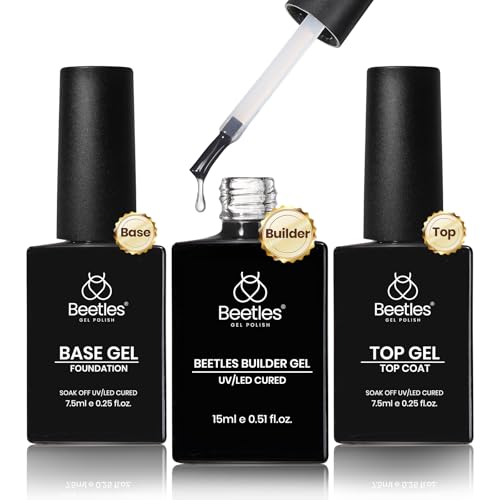
Beetles 3-Piece Clear Builder Gel with Base & Top
$9.99
Amazon price as of Oct 22, 2026
The Three Brush Moves
The whole technique is three moves. That's it. Once you internalize them, the one bead method becomes muscle memory in about 5-10 nails of practice.
Move 1 — The Place
Place the bead at the apex zone (one-third back from the free edge, dead center on the nail). Don't smear it. Don't drag yet. Just touch the brush to the nail and let the bead transfer.
The brush should be at a 45-degree angle to the nail, flat side down. The bead sits on top of the nail like a small dome.
Move 2 — The Cuticle Walk
With the brush still touching the gel, drag the brush slowly toward the cuticle. Stop about 1 mm short of the cuticle line. Lift the brush.
This first move accomplishes two things — it thins the cuticle-side portion of the gel (where you want it thinnest) and it sets the boundary of the gel zone before you start spreading to the sides.
The motion is slow. Count "one, two, three" while you drag. Faster = more bubbles, less control.
Move 3 — The Sidewall and Tip Spread
Re-enter the gel at the apex zone (not from above — slide the brush in laterally from the side you just left). Pull the gel to the left sidewall, stopping 1 mm short. Re-enter laterally, pull to the right sidewall. Re-enter, pull toward the free edge and over the tip if doing a free-edge cap.
The brush is essentially walking a star pattern out from the apex without ever lifting fully off the gel.
Why It Cures Smoother
Here's the part videos can't show you because cure happens in 30-60 seconds inside a lamp.
When you have a continuous, single-bead application, surface tension pulls the gel into its lowest-energy shape — a dome with a smooth top. The cure preserves that shape exactly.
When you have multiple beads merged together, surface tension fights against the visible seams between them. The cure freezes the gel before surface tension finishes the merge, leaving micro-ridges along the seam lines.
Under matte top coat the multi-bead seams disappear. Under glossy top coat they show as wave patterns when light hits them at the right angle. The one bead method eliminates the seams at the source.
When the One Bead Method Fails
Three failure modes show up. Naming them in advance helps you catch them in the moment.
Failure 1 — Bead too big, floods the cuticle. The fix is smaller next time. If it's already happened, wipe the cuticle with alcohol on a lint-free wipe BEFORE curing, then continue.
Failure 2 — Brush dragged too fast, ripples form. Cured gel shows visible wave lines parallel to the brush direction. Fix mid-cure is impossible. After cure, file the ripples down with a 220-grit buffer before top coat.
Failure 3 — Brush lifted off accidentally during the spread. Creates a seam. If you notice during application, dip the brush in slip solution or alcohol and gently re-blend the seam BEFORE curing.
For a broader troubleshooting list, see builder gel mistakes to avoid.
What Lamp Time Changes
The one bead method places a slightly thicker dome in the apex zone than the multi-bead method does. Standard lamp time recommendations need a small adjustment:
| Lamp wattage | Beginner multi-bead | One bead method |
|---|---|---|
| 36 W LED | 60 seconds | 75-90 seconds |
| 48 W LED | 60 seconds | 60-75 seconds |
| 80+ W LED | 30-45 seconds | 45-60 seconds |
If your lamp is under 48 W, you should already be considering an upgrade for builder gel use. See the best builder gel kit with lamp write-up for fully-bundled options.

OPI GELement LED Cure Gel Nail Polish Starter Kit
$59.99
Amazon price as of Oct 22, 2026
Building Toward It
If the technique feels intimidating, build to it in three sessions:
- Session 1 — Do a normal multi-bead set. Practice the slow brush drag at the very end, just to feel the gel move.
- Session 2 — Use a slightly larger bead than usual and merge only two beads instead of three. Brush-walk between them.
- Session 3 — Full one bead method. Should click on the third or fourth nail.
Most people I've taught make the full switch in under 90 minutes of practice.
The Bottle vs. Tube Question
The one bead method works with both bottle brush-on formulas and tube formulas, but with a critical difference.
Tube formulas need a separate gel brush and slip solution. The bead comes off a metal spatula, not the brush. The technique still works — you place the bead with the spatula, then use the gel brush (dipped in slip solution) for the spread moves.
Bottle brush-on formulas are simpler — the bead comes off the bottle brush itself, and the same brush does the spread moves. For one bead practice, start with a brush-on bottle.

Modelones Builder Nail Gel 3-Pack with Top Coat
$13.98
Amazon price as of Oct 22, 2026
For a deeper comparison of bottle vs. tube formats, see best builder gel in a bottle.
When NOT to Use One Bead
The technique has limits. There are three scenarios where multi-bead is still the better choice:
- Sculpting an extension on a nail form — you need controlled volume placement at the free-edge build-out zone, not a single dome. Multi-bead with sculpting brush.
- Repairing a crack mid-set — fill the crack with a tiny bead, cure, then a second tiny bead over the top to smooth. Single-bead can't reach into a crack.
- Color builder gels with pigment — heavily pigmented gels are too opaque for surface tension to do the smoothing work. You'll see brush marks regardless. Multi-bead with a top coat correction is often easier.
For the color-application use case, see builder gel nail polish.
What "Watch Me Do It" Videos Don't Show
A few details from the in-salon version of this technique that almost never make it into video tutorials, because the creators do them unconsciously:
The wrist anchor. Pros rest the wrist holding the brush on the table or against the client's hand. The bracing eliminates wrist micro-shake, which is what makes brush ripples appear in cured gel. If your wrist is unsupported, slow movements still tremor. Brace before every nail.
The breath hold. During the slow drag toward the cuticle (Move 2), most pros hold their breath. Breathing causes hand micro-movement. The drag takes 3-5 seconds, well within a single breath hold.
The light angle. Watching the bead from directly above is what beginners do. Watching from the side (looking across the nail surface at a low angle) shows the actual dome shape much more clearly. Tilt your head — don't look down on the nail, look across it.
The pre-cure check. Right before cure, pros tilt the finger up and down (the "flag pole" — see builder gel apex placement) to redistribute gel. The one bead method places the dome correctly to start, but the flag pole sets the final shape.
The cure-then-look pattern. Pros cure first, then look at the result, then either accept or correct on the next nail. They don't second-guess mid-application. This makes them fast. Beginners stop mid-application to inspect, which causes the gel to start self-leveling out of the deliberate dome shape.
Adapting the Bead to Nail Size and Shape
The one bead method is one bead per nail, not one bead size for every nail, and the most common way it goes wrong is using the same pull for a thumb and a pinky. Here is how I scale it.
For a thumb, the bead is roughly the size of a lentil; for the index and middle fingers, a little smaller; for the ring finger, smaller again; and for a pinky, about half the thumb bead — closer to a peppercorn. Pull too much on a pinky and there is nowhere for the gel to go except over the sidewalls and onto skin; pull too little on a thumb and the apex ends up thin over the widest, most-stressed nail on the hand.
Shape matters as much as size. On a flat, wide plate, place the bead slightly further back toward the cuticle than usual and rely on the cuticle walk to keep it thin at the back, because flat plates let gel run forward. On a nail with a strong C-curve, place it slightly forward, because the curve holds gel at the sides and you will otherwise end up with a thick center stripe. On a nail that dips at the free edge — a "ski-jump" plate — the bead goes over the dip, not the center, and the apex is built where the stress will be, which is not where a symmetrical nail would put it. Get the bead right for each nail and the three brush moves stay identical; that is the whole reason the method is repeatable.
Cited Reading
The American Academy of Dermatology covers acrylate sensitization and skin-contact precautions during gel application — required reading for anyone working close to the cuticle, regardless of which method you use. Read their acrylate allergy patient resource before set 1.
Related Reading
- Builder gel nails (homepage) — the topic hub for everything in this guide
- Builder gel application steps — full application sequence
- Builder gel mistakes to avoid — the failure modes catalog
- Builder gel tutorial — long-form video-companion walkthrough
- How to do builder gel nails — beginner-friendly version
- Best builder gel for beginners — product picks if you're starting fresh
Last updated September 2026. This article uses AI assistance for research and structure; the method notes are written from in-salon experience with the one bead method across roughly 200 sets on real clients.