Hard gel nails are a nail enhancement made from a thick gel that hardens under a UV or LED lamp and is formulated not to break down in acetone, so it has to be filed off rather than soaked off. They are used for sculpted extensions, overlays on tips and repairs, and they sit between soak-off builder gel and acrylic: lamp-cured like gel, removed by filing like a heavy enhancement.
That removal method decides almost everything else about them. For narrower questions the site has dedicated pages: the builder gel vs hard gel comparison goes deep on the two gels, how to remove hard gel walks through the file-off step by step, and best hard gel for beginners compares specific products.
How Hard Gel Works
"Hard" describes how the gel comes off, not simply how strong it feels. Essie, a nail polish manufacturer, draws the line clearly in its gel removal guide: "most gel nails can be soaked off with acetone", but "hard gels can only be filed off, preferably by a professional manicurist." Soak-off gels, including gel polish and most builder gels sold in a bottle, soften when wrapped in acetone. Hard gel does not, so the only way to remove it is to file the material away.
In practice, hard gel usually comes in a jar or pot as a thick, paste-like gel that is scooped and placed with a brush, then cured. The two hard gel products this site already lists show the pattern. The Beetles Hard Gel extension kit contains three 1 oz jars of hard gel and prints a cure time of 60 to 120 seconds under a UV & LED lamp. The IBD Hard Gel LED/UV Builder Gel is a 2 oz jar that lists "3-4 minutes under UV light". Both are sold for building length and structure: the Beetles listing names extensions, apex sculpting, repairs and reinforcing tips, and the IBD listing names overlays and sculpting (both read from the brands' Amazon listings through Amazon's data feed, 13 November 2026).
The Beetles listing also notes that cold makes the gel more viscous and suggests warming the jar in 122–140°F water for three to five minutes, a reminder that hard gel is meant to be thick enough to hold a sculpted shape on a form.
The labelling problem
The words on the bottle are not reliable. "Hard" appears in product titles for gels that the same listing calls soak-off: IBD's smaller Building Gel is titled "Hard Builder Gel for Nails Extensions, Soak-Off UV/LED". If the label does not say soak-off, assume it files off. The simplest check on a finished set is to wrap one nail in acetone, as the removal guide describes, and see whether the surface softens. Soak-off gel softens; hard gel does not.
Hard Gel vs Soak-Off Builder Gel vs Acrylic
The three products overlap in what they do (add strength and length) but differ in how they harden, how they come off, and what that means for the natural nail underneath. Each row below comes from a named source.
| Hard gel | Soak-off builder gel | Acrylic | |
|---|---|---|---|
| What it is | Thick gel, usually from a jar, placed with a brush | Gel in a bottle or pot, often with a built-in brush; thinner than hard gel | Acrylic monomers (such as ethyl methacrylate) reacted with acrylic polymers (such as polymethylmethacrylate), per the FDA |
| How it hardens | Cured under a lamp; cure time is per brand (Beetles 60–120 s UV & LED; IBD 3–4 min UV) | Cured under a lamp; the AAD notes gel nails "require ultraviolet (UV) light to harden" | Through the monomer–polymer reaction described by the FDA, not a gel cure |
| Removal | Filed off only; Essie says "preferably by a professional manicurist" | File the surface, then 100% acetone for 10–15 minutes (Essie) | Soak in acetone or file off (AAD) |
| What the AAD says about the nail | Asks people to choose gel that soaks off "rather than ones that must be filed off" | Its preferred option: gel is more flexible than acrylic, so the natural nail is less likely to crack | The nail surface is filed until rough to make acrylic stick, which thins it |
| Upkeep | Touch-ups every 2–3 weeks for artificial nails worn longer than a few weeks (AAD) | Same AAD guidance | Same AAD guidance |
| Main use | Sculpted extensions, tip overlays, repairs | Overlays on natural nails, shorter extensions | Extensions and overlays |
| Allergy note | Gel listings warn of allergic reaction on skin contact | Same | FDA: traces of reactive monomer can cause redness, swelling and pain in sensitised people |
Sources: Essie gel removal guide; AAD: Artificial nails, tips for reducing nail damage; FDA: Nail Care Products; Beetles and IBD Amazon listings. All read November 2026.
Three things in that table matter most.
Removal is the real dividing line. Soak-off builder gel and hard gel can look identical on the hand; the difference shows up on removal day. With soak-off builder, Essie's advice is to file down "a lot more of the gel thickness before soaking with acetone", then let the acetone do the rest. With hard gel there is no soak stage at all; every bit of material comes off by filing. The American Academy of Dermatology's gel removal guidance warns that "picking or filing off gel nail polish can significantly damage your nails." That warning is about gel polish, but it explains why a file-only product carries more risk at removal.
Acrylic is chemically a different system. The FDA describes artificial nails as made "by reacting together acrylic monomers, such as ethyl methacrylate monomer, with acrylic polymers, such as polymethylmethacrylate", and notes that traces of monomer remain after the nails are formed. Hard gel is often pitched as an acrylic alternative (IBD's listing promises "acrylic strength, gel clarity"), but the comparison is about the finished result, not the chemistry.
Nobody publishes a durability ranking. There is no independent, industry-wide measurement of how long each system lasts or how often it breaks. Brands make their own claims (the Beetles hard gel listing says sets "last up to 28 days"), and those are marketing, not test results. The full builder-versus-acrylic trade-off is covered on the site's builder gel vs acrylic page.
How a Hard Gel Set Is Applied
A hard gel manicure follows the same broad sequence as any lamp-cured enhancement; what changes is the thicker product and the amount of filing afterward. This is general technique, not a substitute for the label on your product, especially for cure times.
- Prep the natural nail. Shape the free edge and lightly remove the shine so the gel has something to grip. Leave the cuticles alone: the AAD's gel manicure tips say to "never let your manicurist push or cut your cuticle, as this could lead to inflammation and infection."
- Protect the skin from the lamp. The same AAD page recommends a broad-spectrum, water-resistant sunscreen with SPF 30 or higher on the hands, or dark, opaque gloves with the fingertips cut off, before curing.
- Add length if wanted. Hard gel is used either over tips glued to the nail or sculpted on a paper or reusable form that sits under the free edge. The Beetles kit, for example, ships with 100 forms and 288 half-cover tips for exactly these two methods.
- Build the structure in layers. A thin base layer is cured first, then a bead of thicker gel is placed and guided into shape, with the highest point (the apex) over the stress area of the nail. Each layer is cured for the time the label states.
- Keep gel off the skin. Any gel that touches the side walls or cuticle area should be cleaned away before curing. The FDA's advice on artificial nail ingredients is direct: "It is important to avoid contact with the skin in order to minimize the chance of an allergic reaction." The Beetles listing repeats that warning and says to stop using the product if redness and itching develop.
- File, refine and seal. Once cured, the nail is shaped with a file, buffed, and finished with a top coat or a final gloss layer.
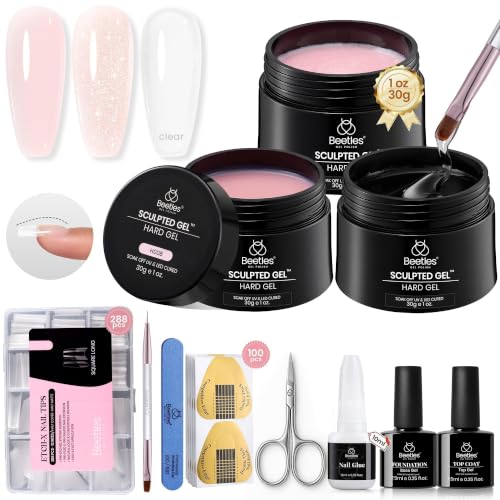
Beetles Hard Gel for Nails Kit (3 Colors)
$29.99
Amazon price as of Nov 15, 2026
The site's builder gel extensions guide covers forms, tips and apex placement in more detail; the same structure rules apply to hard gel.
The Life of a Set: Wear, Fills and Removal
Every set goes through the same five stages, summarised below with what the cited sources say at each point.
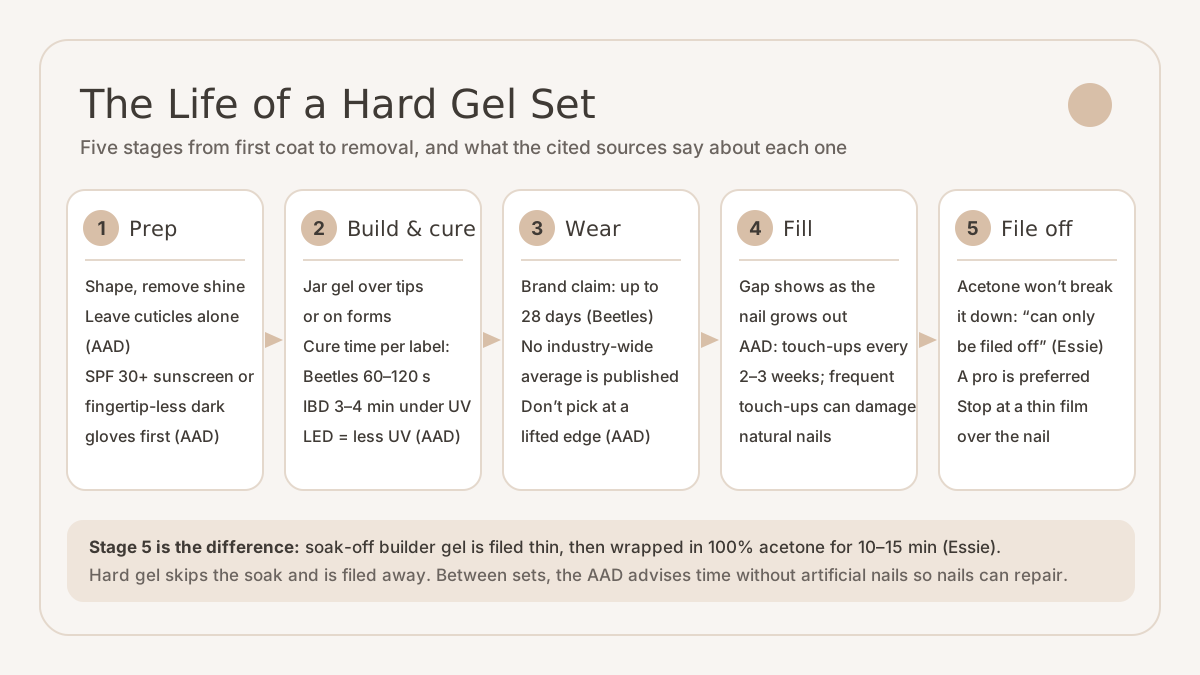
Diagram produced by BuilderGelNails.com from the AAD (artificial nails, gel manicures), Essie's gel removal guide and the Beetles and IBD Amazon listings; read November 2026.
Wear. How long a set holds depends on the product, the application and the wearer's hands; there is no published average. During wear, the AAD's advice for gel is "don't pick at the polish or use other nails or tools to remove it."
Fills. Nails keep growing, so a gap opens at the cuticle end. The AAD says that "if you want to wear artificial nails for more than a few weeks, you'll need touch-ups every 2 to 3 weeks to fill in the gaps that appear as your nails grow," and adds that "frequent touch-ups can seriously damage your natural nails." With hard gel, a fill means filing back the existing gel to reshape and rebalance it before new gel goes on, so the file is in use at every appointment, not only at removal.
Removal. Because acetone will not dissolve hard gel, the set is taken down by filing until only a thin film remains over the natural nail, then buffed smooth. Essie's recommendation is a professional. The how to remove hard gel page gives the full hand-file method and explains why an electric file is best left to trained technicians.
Breaks. The AAD suggests reserving artificial nails for special occasions and going without them in between, to give "your nails a chance to repair themselves."
Pros and Cons of Hard Gel
Hard gel's strengths and weaknesses come from the same two properties: it is thick and it does not dissolve.
Advantages
- Built for length. Brands sell hard gel specifically for sculpted extensions and overlays on tips, and the thick consistency holds a shape on a form.
- Shaped before it sets. Gel hardens under the lamp, so each nail can be shaped before curing; acrylic hardens through its own monomer–polymer reaction.
- Acetone does not affect it. The property that makes removal harder also means a splash of remover will not soften the set.
Disadvantages
- Removal is all filing. Essie recommends a professional, and the AAD warns that filing gel off can significantly damage nails. This is the biggest drawback for anyone doing their own nails.
- Fills involve filing too. Every two to three weeks the existing gel is filed back before new gel is added.
- Allergy risk is the same as other gels. Gel listings warn about allergic reactions from skin contact, and the FDA describes how reactive methacrylate monomers can cause "redness, swelling, and pain in the nail bed" in people who have become sensitive. Nail products also "do not need FDA approval" before sale.
- UV exposure at every cure. Several cures per hand means repeated lamp time. The AAD says LED "emits lower levels of UV radiation than a UV curing light" and cures faster; use one only if the gel's label lists an LED cure time.
Who Hard Gel Suits, and Who Should Pick Something Else
Hard gel nails make the most sense for a narrow group, and a soak-off product is the better default for everyone else.
Good fit:
- People who want long sculpted extensions and will have them done, filled and removed at a salon that offers file-off removal.
- Nail technicians and trained hobbyists comfortable with hand-filing or an electric file, who want a thick gel that holds shape on forms.
Better served by soak-off builder gel or a break:
- Short natural nails that just need strength. A soak-off builder gel does the same reinforcing job and comes off with acetone.
- First-time, at-home users. The first removal of a hard gel set is the riskiest part, and it comes at the end of every set.
- People who change shape or colour often. Each change means a full removal or heavy filing.
- Nails that are already brittle, soft or damaged. The AAD says covering them "can worsen existing nail problems."
- Anyone who has reacted to gel before. Redness, itching or swelling around the nail after a gel set is a reason to stop and see a doctor, not to switch brands. The FDA asks people who have a reaction to a nail product to report it to the agency.
For the wider product family, from soak-off builder in a bottle to overlays on natural nails, the builder gel nails homepage links to every guide on the site.
Frequently Asked Questions
Are hard gel nails bad for your natural nails?
They are not automatically damaging, but the removal method raises the risk. The AAD says artificial nails in general can leave nails "thin, brittle, and parched," recommends gel that soaks off rather than gel that must be filed off, and warns that filing gel off can significantly damage nails. Trained filing, uncut cuticles and breaks between sets lower the risk.
Can hard gel be soaked off with acetone?
No. Essie states that hard gels "can only be filed off." If a product labelled "hard" softens in acetone, it is a soak-off builder gel sold under a loose name. Wrapping one nail in 100% acetone for about ten minutes, as in the AAD's gel removal method, shows which kind is on the nails.
How long does a hard gel set last?
There is no independent average. The Beetles hard gel listing claims sets "last up to 28 days," which is the brand's own marketing. The AAD's guidance for artificial nails worn longer than a few weeks is touch-ups every two to three weeks as the nails grow, so the practical rhythm is a fill or a removal every few weeks.
Is hard gel the same as builder gel?
Not exactly. Both build structure, but "builder gel" on most labels means a soak-off product, while true hard gel is file-off. Read the removal instructions rather than the name. The builder gel vs hard gel comparison covers the differences in detail.
Does hard gel need a UV or an LED lamp?
They need whichever lamp type the label lists. The Beetles kit gives a time for UV & LED lamps; the IBD 2 oz jar lists a time under UV. The AAD notes that LED lamps emit lower levels of UV radiation and cure faster, and recommends sunscreen or fingertip-less gloves either way.
Is hard gel better than acrylic?
Neither wins in every case. Hard gel is lamp-cured, so it can be shaped before it sets; acrylic can be soaked in acetone or filed off (AAD), while hard gel can only be filed. For nail health, the AAD's stated preference is soak-off gel over both.
Last updated November 2026. This article is researched with AI assistance and edited before publication; it draws on manufacturer instructions and the sources cited on this page.