Builder gel extensions are what most people mean when they say they want "builder gel nails" and then look disappointed when the tech says "overlay": actual added length, three to eight millimetres past the natural free edge, sculpted from gel over a form or built up on a soft-gel tip. They are the most satisfying thing to learn in builder gel and the thing most home tutorials skip, because they need a firmer gel, a different apex, and a couple of sets of patience. I have sculpted extensions for eight years and taught a lot of people to do their own, so this page is the version I teach: what builder gel realistically can and cannot do at length, whether to use forms or tips, the twelve steps, and the three ways a first extension set goes wrong. If you have never done a builder overlay, do one first — the how to use builder gel tutorial is the foundation, and the Builder Gel Atlas explains the product.
What Builder Gel Extensions Can and Cannot Do
Builder gel is a soft-to-medium gel, and length is where that matters. Here are the honest limits, by gel type, from my own sets and repairs:
| Gel type | Realistic added length | Wear at that length | Removal |
|---|---|---|---|
| Soft self-leveling builder (most bottles) | 2–4 mm | 2–3 weeks; flexes, occasional corner crack | Soak-off |
| Medium/firm builder ("sculpting" or "hard builder" in a bottle) | 4–8 mm | 3 weeks; holds an apex well | Soak-off or file-off depending on brand |
| True hard gel | 8 mm+ | 3–4 weeks; rigid | File-off only |
| Builder over a soft-gel tip | Whatever the tip provides, 5–12 mm | 3 weeks+ | Soak-off |
So: short extensions on any builder, medium extensions on a firmer builder, and if you want long and dramatic you are really shopping for hard gel or a tip system. Most people asking for builder gel extensions want three to six millimetres — "past the fingertip, but still mine" — and that is squarely what a firm builder does well. The gels ranked in best builder gel for nail extensions are the ones that hold an apex at that length.
Forms or Tips? Decide This First
There are two ways to get length with builder gel, and they suit different people.
Sculpting over a form means fitting a paper or dual form under the free edge and building the extension from gel in the air, with nothing but the form supporting it. You get any shape and any length, the result follows your own nail's curve, and there is no seam. It is also the harder path: fitting the form is fiddly, the gel has to be firm enough not to sag, and your first two sets will be lumpy. Forms are what I use on clients who want a natural-looking medium length.
Building on a soft-gel tip means gluing a pre-shaped tip on with builder gel, then sculpting a thin builder layer over the whole nail for structure. The tip does the shaping, so it is faster and more consistent, and the builder layer over it is an ordinary overlay you already know how to do. The trade-off is that the shape is whatever the tip is, and there is a seam to blend. Tips are what I hand to home users doing their first extensions.
If you are unsure: tips first, forms once you are confident. The nail forms for builder gel guide compares paper, dual and tip forms in detail, and the builder gel on full tips page covers the tip route specifically.
Extension supplies — Amazon
Forms, a firm three-color builder, and a clear extension kit
The Nailskey and Nelrona forms are the ones I keep at the table; the Modelones hard builder holds an apex at 6 mm; the Makartt kit is the budget clear that sculpts.

Nailskey Nail Forms for Builder Gel, 100 pcs
$3.99
Amazon price as of Oct 5, 2026

Nelrona Nail Forms for Poly & Builder Gel, 312 pcs
$8.99
Amazon price as of Oct 5, 2026

modelones Nail Art Practice Tips Builder Nail Gel 3 Colors French Tip, 10-in-One Builder Clear Nude Pink Hard Gel Nail Kit with Dual End Brush, Paper Forms for Extension Apex Building Sculpting
$16.99
Amazon price as of Oct 5, 2026
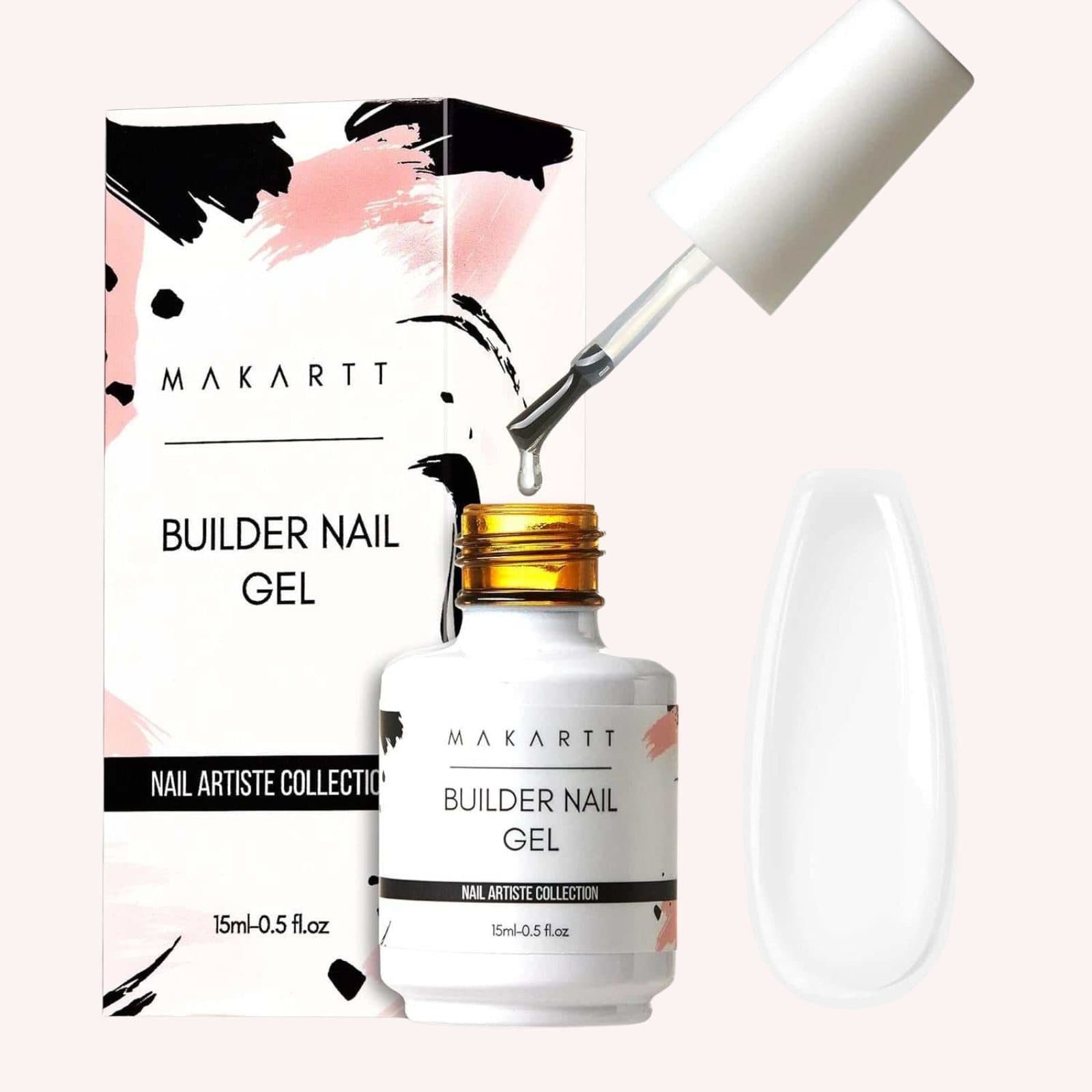
Makartt Clear Gel Builder Kit
$15.99
Amazon price as of Oct 5, 2026
Scroll →
Product prices and availability are accurate as of Oct 5, 2026 and are subject to change.
What You Need
Beyond the standard overlay kit — lamp, base, top, prep tools — extensions need four things: a firm builder gel (a soft self-leveler will sag off the form), forms or tips, a flat builder brush with some stiffness (the bottle brush cannot push gel into a form), and a 180-grit file for shaping the free edge. Nice to have: a dual-form kit if you want the fastest possible sculpt, and an e-file for the refine step once you have done a few sets. I would not buy the e-file for a first extension set; it is the tool most likely to thin the natural nail in new hands.
The 12-Step Builder Gel Extension Method (Forms)
This is the sequence I use on a sculpted medium-length set, and the one I teach. Steps one to four are the same prep as an overlay; the extension starts at step five.
- Prep the natural nail. Push back cuticle, remove any non-living tissue, buff the shine, dehydrate. On extensions, prep matters even more than on an overlay because the lever arm of the extension pulls on the bond.
- Shape the free edge short and straight. Extensions build cleanest off a short, squared natural edge — a millimetre or two is ideal. Long natural nails under an extension are a weak point.
- Apply and cure base coat. Thin, cured fully.
- Fit the form. Slide the paper form under the free edge so it sits snug against the nail with no gap, and the form's centre line follows the nail's centre. A gap here becomes a bubble or a hollow later. Pinch the form so its curve matches the nail's C-curve.
- Lay the slip layer. A whisper-thin coat of builder over the natural nail and onto the form to the length you want. Flash cure ten seconds.
- Build the extension body. Place a bead at the free edge of the natural nail and draw it out onto the form to the tip, keeping it thinner at the far end. This is the length. Flash cure.
- Build the apex. Place the main bead over the stress point — which on an extension has moved forward, to where the natural nail ends and the extension begins — and float it so it is highest there and thins toward the cuticle and the tip. Turn the hand upside down for the first ten seconds of the flash cure so gravity holds the dome.
- Full cure. The full time on the bottle, plus thirty seconds on a firm builder, because these layers are thick. Thumbs cured separately, centred in the lamp.
- Remove the form. Peel it away from the underside. The extension should feel solid; if it flexes at the join, it is under-cured or too thin — add a thin bead over the join and cure again.
- Shape. File the free edge to length and shape with 180 grit, then the sidewalls straight, then bevel the underside of the tip slightly so it is not a sharp ledge.
- Refine the surface. Smooth the apex and blend any ridges with 180 then 240 grit. On an extension, do not thin the apex — it is what stops the nail snapping at the join.
- Top coat and cap. Wrap the top coat over the free edge and under it a hair, cure, wipe, oil. Capping is the difference between a two-week and a three-week extension.
The apex step is the one to obsess over. On a natural-nail overlay the apex sits over the centre of the nail; on an extension it moves forward to the join between nail and gel, because that is where the nail will bend. Build it there and the extension holds; build it where you would on an overlay and the tip cracks at the join in week two. The builder gel apex placement guide has the diagrams.
Extensions on Short or Bitten Nails
The most common question I get is whether you can do builder gel extensions on very short or bitten nails, and the answer is yes, with two adjustments. First, keep the added length modest — two to four millimetres — because a short natural nail gives the extension a short anchor, and the longer the lever the more force on that anchor. Second, use a tip rather than a form on a nail with no free edge at all: a form has nothing to sit under, and a tip gives you the shape without needing one. Bitten-nail clients are also the ones who benefit most from extensions, because a covered, slightly lengthened nail is the thing that finally breaks the biting habit; the best builder gel for nail biters guide is written for exactly that case, and the builder gel on short nails page covers short-nail technique generally.
Read next
Best Builder Gel for Nail Extensions in 2026: 7 Picks Ranked by Sculpting Stability
The best builder gel for nail extensions has to do something most builder gels can't: hold an apex over a free edge that sticks out 5mm past the natural nail. Here are the seven gels that actually deliver — sorted by how you plan to build.
Continue readingThree Ways a First Extension Set Goes Wrong
It sagged on the form before cure. The gel is too soft, or the bead was too big, or you took too long between placing it and flash-curing. Fix: firmer gel, smaller beads, and flash-cure each nail before moving to the next rather than doing all five and then curing.
It cracked at the join in week two. The apex was built too far back, over the natural nail, instead of over the join. Fix: move the main bead forward. Also check the natural free edge was short — a long natural nail under an extension is a hinge.
It lifted at the cuticle. Same as any builder set: prep, or gel on skin. Extensions make this worse because the lever arm pulls at the cuticle edge. Fix: better prep, keep the gel a hair away from the cuticle, and keep the extension short until your cuticle edge is consistently clean. The builder gel lifting fixes page diagnoses by timing.
Removal and Fills on Extensions
A sculpted builder extension fills like an overlay: at two to three weeks, file the regrowth and the top coat smooth, rebuild the apex where it has moved back with growth, top coat. Extensions can usually take two fills before the structure is too thick and it is time to soak off. Removal is the same acetone-and-foil process as an overlay, twenty-five to forty minutes because the layers are thicker; file the length off first so there is less gel to dissolve. The one thing never to do is snap or pry an extension off — the join is strong enough that it takes natural nail with it. The how to remove builder gel tutorial covers the safe version. And whether you are sculpting or overlaying, keep uncured gel off the skin around the nail; the American Academy of Dermatology's overview of contact dermatitis explains why repeated exposure is the risk that matters.
Frequently Asked Questions
Can you do extensions with builder gel?
Yes. Builder gel extensions of two to eight millimetres are standard salon work, sculpted over a form or built on a soft-gel tip. Very long extensions are better done in hard gel or with a tip system, because builder gel is designed to flex.
How long do builder gel extensions last?
Two to three weeks before the first fill at short-to-medium length, and five to six weeks total with fills. Wear drops as length increases; past about six millimetres a soft builder starts cracking at the join.
Can you do builder gel extensions on short nails?
Yes — keep the added length to two to four millimetres and use a tip rather than a form if the natural nail has no free edge for a form to sit under. Short nails are the best anchor for a first extension set.
Which is better for extensions, builder gel or Gel X?
Gel-X is faster and more uniform; builder gel gives you custom shape and length and fills instead of redos. Many pros combine them — a Gel-X tip for length, builder over it for strength. The difference between Gel X and builder gel page covers when each wins.
Do builder gel extensions damage your nails?
Not when applied and removed properly. Damage comes from prying extensions off, over-filing the natural nail at refine, and skin contact with uncured gel. Keep extensions short, soak them off, and take a bare week between cycles.
Is builder gel strong enough for extensions?
For short and medium extensions, yes, especially a firm-viscosity builder. For long or dramatic length, a hard gel or acrylic is stronger; the builder gel vs hard gel comparison covers the line between them.
What builder gel should I use for extensions?
A firm or "sculpting" viscosity, not a self-leveling clear. The best builder gel for sculpting extensions list ranks the ones that hold an apex on a form; everything else on the site is mapped from the home page.
Last updated October 2026. This article uses AI assistance for research and structure; the method, length limits and failure modes come from eight years of sculpting extensions on clients and teaching the technique.