Choosing the right nail file for builder gel is the difference between a clean apex refine and a thinned natural nail plate. Each step in a builder gel set wants a different grit — prep buffing, free-edge shaping, gel refining, removal, and post-removal smoothing all call for different files. This guide maps the grit numbers to the steps, then names the file types worth buying. For broader system context, see the Builder Gel Atlas.
Kits That Ship With the Right Files
Builder gel kits with quality files included
The Amazon-stocked kits below bundle 100/180 and 240 files — the two grits that cover 90% of builder gel work.

TsMADDTs Nail Files and Buffers, Professional Manicure Tools Kit Rectangular Art Care Buffer Block Tools 100 180 Grit 12 pcs(Black)
$5.99
Amazon price as of Sep 19, 2026
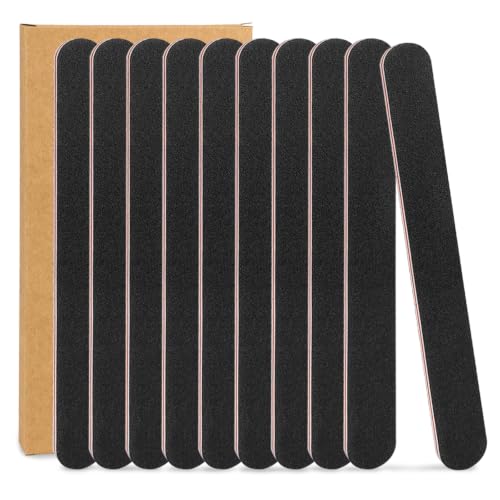
HeeYaa 5 Rows 2 Layers 10 PCS Nail File, Red Tough PP Core, Exquisite Kraft Paper Box, Double Sided 100/180 Grit Black Emery Board Manicure Pedicure Nail Tool
$3.97
Amazon price as of Sep 19, 2026

Maryton Nail Buffer Blocks, Fine Grit 180/240 Professional Salon Quality 3 Way Blue Buffing Blocks for Natural Nails - Buff Nails Prior to Application of Gel Polish, Acrylic, 5 Count
$4.99
Amazon price as of Sep 19, 2026

Teenitor Nail File Nail Buffer, 6 pcs Nail Files and Buffers for Natural Nails, Emery Boards for Nails, Nail Buffer and Shine Kit Nail Filer, Nail Buffer Block 100/180 Grit Nail Files Fingernail Files
$6.99
Amazon price as of Sep 19, 2026
Scroll →
Product prices and availability are accurate as of Sep 19, 2026 and are subject to change.
File Grit Quick Reference
Each step in a builder gel set wants a different file grit. The wrong grit at the wrong step damages either the gel or the natural nail.
| Step | Recommended Grit | What it does |
|---|---|---|
| Prep buffing (remove shine) | 240 | Light surface scuff, no thinning |
| Free-edge shape (before gel) | 180 | Shape natural nail edge cleanly |
| Refining cured gel | 180 → 220 | Smooth apex shape, blend transitions |
| Final smoothing pre-top-coat | 240 → 1000+ buffer | High-shine pre-finish |
| Bulk file-down at removal | 100/180 | Fast bulk removal of cured gel |
| Light file-down at removal | 180 | Slower, controlled removal |
| After-removal natural nail buff | 240 | Smooth residual gel without thinning |
If you only buy two files, get a 100/180 dual-side and a 240 buffer. They cover most of the workflow.
What File Grit Numbers Mean
The number is the grit count — particles per square inch on the file surface. Lower number = coarser grit = more aggressive cutting.
- 80 grit — extremely coarse. Damages natural nails fast. Avoid for natural-nail work.
- 100 grit — coarse. For bulk gel removal at removal step. Should never touch natural nail.
- 150-180 grit — medium. Versatile workhorse. Free-edge shaping, gel refining.
- 220 grit — fine. Final smoothing on cured gel before top coat.
- 240 grit — fine-medium. Light prep buffing, post-removal smoothing.
- 400-600 grit — very fine. Final smoothing, almost polishing.
- 1000+ grit — buffing/polishing. Used in dedicated buffer blocks for high shine.
The right grit at the right step is more important than buying expensive files. A $4 100/180 file plus a $5 240 buffer covers 90 % of builder gel use.
File Types
Emery Boards (Cardboard / Wood Core)
The cheapest option. Single-use or short-life. Fine for occasional DIY users.
Pros: cheap ($1-3), disposable, hygienic per-set. Cons: wear out quickly, inconsistent grit on cheap versions, environmentally wasteful with frequent use.
Glass / Crystal Files
Single-grit (usually fine, ~280-400 equivalent), reusable, washable. Good for natural-nail edge shaping but useless for bulk gel work.
Pros: reusable for years, hygienic (sterilizable), gentle on natural nails. Cons: too fine for gel bulk removal, breaks if dropped.
Best use: keeping a dedicated glass file for natural-nail edge maintenance between sets.
Padded Foam Files (Buffer Blocks)
Foam core with abrasive on multiple sides. Often labeled with multiple grit numbers (e.g., 100/180/240/600).
Pros: versatile (multiple grits in one tool), cheap, available everywhere. Cons: wear unevenly, can be too soft for aggressive bulk filing.
Best use: the everyday workhorse for most DIY use.
Metal Files
Reusable, sterilizable, single-grit. Sometimes labeled like emery (180, 240, etc.).
Pros: lasts years, sanitizable. Cons: can be aggressive, less common for builder gel work specifically.
Best use: salon environments where sterilization between clients matters.
E-File (Electric Nail Drill)
Motorized handpiece with interchangeable bits. Fast, but requires training.
Pros: dramatically faster bulk removal in trained hands. Cons: generates heat, can damage natural nails in untrained hands. Not recommended for DIY beginners.
Best use: salon professional use. For DIY removal, see no-drill removal.
Read next
How to Remove Builder Gel Without a Drill: The Complete File-and-Soak Method (2026)
You don't need a nail drill to remove builder gel safely at home. The file-and-soak method works with a simple hand file — and it's actually gentler on your natural nails than e-file removal in unskilled hands.
Continue readingStep-by-Step Filing Guide
Step 1 — Prep Buffing (240 grit)
Light buffing to remove shine from the natural nail surface so builder gel adheres. 2-3 strokes per nail, no more.
Common mistake: using 100 grit for prep. This thins the natural nail and is the #1 cause of long-term natural-nail damage among DIY users. Use 240 grit only.
Step 2 — Free-Edge Shape (180 grit)
Shape your natural nail's free edge BEFORE applying gel. Square, oval, almond — whatever shape you want.
Common mistake: trying to shape after gel application only. Cured gel is hard; shaping a hard set is filing more product than needed. Pre-shape the natural nail to your desired shape minus 1-2 mm; the gel adds back the rest.
Step 3 — Refining Cured Gel (180 then 220)
After full cure, refine the apex shape and smooth surface imperfections.
- 180 grit for major shape correction
- 220 grit for smoothing transitions
Common mistake: filing the apex flat. The apex is the structural high point. File around it, not through it.
Step 4 — Final Smoothing (240 + buffer)
Light pre-top-coat buffing for high shine.
Common mistake: skipping this and going straight to top coat. The buffing micro-scuffs the surface so top coat bonds properly.
Step 5 — Bulk File-Down at Removal (100/180)
For removal, file off 80 % of the cured gel. The 100-grit side is for fast bulk removal; the 180 side for cleaner finishing.
Common mistake: filing all the way to the natural nail. Always leave a thin gel layer for acetone to break down.
For full removal protocol, see how to remove builder gel.
Read next
How to Remove Builder Gel at Home Safely: 3 Methods Compared (2026)
Three methods to remove builder gel — file-and-soak, file-only, and salon e-file — compared on time, safety, and nail-health impact. Plus a detailed step-by-step for the safest at-home method.
Continue readingStep 6 — Light Smoothing After Removal (240)
Very light buffing of any residual gel after the soak. Just 1-2 light strokes per nail.
Common mistake: aggressive buffing of the natural nail post-removal. The plate is already at its thinnest after removal — give it a break.
What Files I Actually Recommend Buying
For full DIY builder gel kit, three files cover everything:
- 100/180-grit dual-side foam file — for bulk file-down and free-edge shaping. The workhorse. ~$3-5.
- 220-grit single-side or dual 180/240 file — for refining cured gel. ~$3.
- 240-grit buffer block (4-sided) — for prep buffing and final smoothing. Often comes with multi-grit (240/600/1000+). ~$5.
Total: about $11-13 for a full filing kit that lasts months of regular use.
Files That Come in Builder Gel Kits
Most builder gel kits include 1-2 files. Quality varies:
- Modelones kits: include 100/180 dual-side. Adequate for bulk work.
- Beetles kits: include 100/180 + buffer. Solid combo.
- Olive & June kits: include the brand's signature buffer + file. Aesthetic, slightly underpowered for bulk work.
- Aprés Gel-X kits: include shaping file + buffer.
Most kits skip the 220-grit refining file. Consider adding one.
File Hygiene
For DIY use:
- Clean files with a stiff brush after each set
- Wipe with alcohol periodically
- Replace foam files every 2-3 months of regular use
- Glass and metal files can be sanitized in 90 % isopropyl alcohol or commercial implement disinfectant
- Never share files between users without sanitizing
For salon settings, file disposal between clients is best practice — single-use files are now standard in higher-end salons for hygiene compliance.
Common Filing Mistakes to Avoid
Mistake 1 — Filing too fast. Heat builds up from friction. Slow, deliberate strokes prevent heat damage.
Mistake 2 — Saw-back-and-forth motion on natural nails. Always file in one direction on natural nails (cuticle to free edge or single-direction along the edge). Back-and-forth weakens the nail layers.
Mistake 3 — Coarse grit on natural nails. 100 grit should NEVER touch your natural nail. Only on cured gel.
Mistake 4 — Filing through the apex during refining. Easy to do, hard to undo. Maintain awareness of the apex location.
Mistake 5 — Reusing dirty files. Old files trap gel particles, lose grit, and can transfer bacteria. Refresh regularly.
For diagnostic on filing-related issues (over-thinning, sidewall damage), see builder gel cracking fixes.
Filing Cured Builder Gel Without Heat Spikes
Cured builder gel is a plastic, and filing plastic makes heat. On a fingernail, that heat has nowhere to go but the nail bed, which is why a refine step done wrong feels like a burn. It is not the gel — it is friction — and three adjustments remove it.
Stroke in one direction, lift, and repeat, rather than sawing back and forth. Sawing keeps the file in contact and the temperature climbing; single strokes give the surface a half-second to shed heat. Use less pressure than feels productive: a 180-grit file cuts cured gel with its own weight, and pressing harder mostly makes heat. And keep the file moving across the nail rather than parked on one spot — the "sanding a ridge" instinct is exactly what causes the spike.
If you are using an e-file, the same rules apply with numbers attached. Keep the speed at or below fifteen thousand RPM for refining builder gel, use a medium-grit carbide or ceramic bit rather than a coarse one, and never hold the bit still. If a client flinches, stop; a heat spike that hurts is a heat spike that can lift the gel from the plate and, repeated, damage the nail bed. Slower and lighter is always faster in the end, because you are not redoing a lifted nail next week.
Frequently Asked Questions
Best nail file for builder gel? A 100/180-grit dual-side foam file for bulk work, plus a 220-grit refining file, plus a 240-grit buffer. Together about $11-13. Covers all builder gel filing tasks.
What grit nail file for builder gel? Different grits for different steps. 100 for bulk gel removal, 180 for shaping, 220 for refining, 240 for prep + final smoothing, 600+ for high shine. See the table at the top of this guide.
Nail file for BIAB — same as builder gel? Yes. BIAB is builder gel; same filing rules apply.
Can I use a glass file on builder gel? For natural-nail edge shaping yes. For bulk gel removal no — glass files are too fine to remove cured gel efficiently.
Do I need a 100-grit file for builder gel? Yes for removal. The 100-grit side of a 100/180 file is what makes bulk file-down efficient. Without it, removal takes 2-3x longer.
Best file for shaping builder gel? 180 grit for major shape work, 220 for refining. A 100/180 foam file plus a separate 220 covers both.
Can I use the same file for prep and removal? Technically yes (180 grit works for both), but consistently 100/180 + 240 separately is cleaner and faster.
How often should I replace nail files? Foam files: every 2-3 months of regular DIY use. Glass/metal files: lifetime if cared for. Cheap emery boards: per-set or per-week depending on use.
Are expensive nail files worth it? For DIY home use, no. Cheap 100/180 + 240 buffer combo gets you 95 % of pro file performance. Expensive files are mostly aesthetic and slightly more durable.
Do I need an e-file for builder gel? No. Hand files cover all DIY use cases. E-files speed up pro salon work but cause more damage than they save time on for amateur users.
A Note on Filing and Acrylate Sensitization
Aggressive filing during builder gel removal also generates airborne particles that can trigger respiratory sensitization in frequent users. The American Academy of Dermatology covers acrylate contact concerns — for techs and high-volume DIY users, gentle hand filing with a dust mask is meaningfully safer than aggressive e-file work without protection.
If you DIY frequently, a $10 dust mask plus the soak-off file-and-soak protocol cuts cumulative exposure dramatically over years.
Final Notes from Sara
Filing technique determines as much of your set's outcome as the gel formula. The right grit at the right step protects natural nails AND produces a cleaner gel finish.
For most home users, three files ($11-13 total) covers years of DIY use. Replace the foam files every few months as they wear out.
For full builder gel application context, see how to use builder gel. For removal specifics, see how to remove builder gel and no-drill removal.
If you're seeing damage or thinning to natural nails, the cause is almost always filing-related. Switch to gentler grits and slower strokes — the difference is dramatic across multi-set cycles.
Last updated September 2026. This article uses AI assistance for research and structure; all filing recommendations come from my own salon and DIY practice.