What is rubber base gel, and is it just builder gel with a new name? No. Rubber base gel is a flexible gel base coat with more body than a regular base: thinner than builder gel, thicker than a standard gel base, and used in place of the base coat rather than on top of it. It suits soft, thin or bendy nails that need support without a rigid shell.
Brands sell it as a clear base, as a tinted "2-in-1" base and colour, and as the first layer under builder extensions. This guide sorts out where it sits in the layer stack and how to choose between it, builder gel and an ordinary gel base coat, using only what manufacturers state for their own products and dermatologist guidance for removal. If you are new to the whole category, the builder gel nails homepage covers the basics first.
What Rubber Base Actually Is
Rubber base is a soak-off gel product, cured under a UV/LED lamp like the rest of a gel manicure. What sets it apart is its thickness and its flex, not a different chemistry you need to learn.
A base coat with more body
Gelous, a gel polish brand, describes its rubber base coat as "thinner than Builder Gel, but thicker than regular Base Coat" in its builder gel vs rubber base guide. The same page is clear about its job: rubber base "replaces your regular Base Coat." It is not an extra layer in the stack. You swap the thin base for the thicker one and carry on with colour and top coat as usual.
The GelBottle, the company behind BIAB™, calls its Rubber Base a "flexible, high-viscosity formula". High viscosity is the technical way of saying it is thick in the bottle and self-levels less than a runny base. That extra thickness is what lets it smooth over ridges and give a weak nail a little more support.
Flexible, not rigid
The word "rubber" refers to the finish once cured. The GelBottle says its rubber base "moves with the natural nail to prevent chips and cracks." Gelous says it "bends with your nails, helping to prevent lifting and cracking for those with flexible nails."
That flexibility is the main reason to choose it. A thin nail flexes every time you type or open a can; a rigid coating does not, and the mismatch is where cracks and lifting start.
Clear, tinted and "2-in-1" versions
Rubber bases come in three broad forms:
- Clear, used purely as a base under colour gel.
- Tinted or milky (sheer pinks, nudes and whites), worn alone as a natural-looking finish.
- "2-in-1" base and colour. Pink Gellac describes its Rubber Base as "a 2-in-1 gel polish" in its rubber base explainer, meaning the tinted base can be the colour too, so no separate colour layer is needed.
Claims on the bottle differ between brands. Pink Gellac lists its Rubber Base as HEMA-free, while The GelBottle's Rubber Base lists 2-hydroxyethyl methacrylate (HEMA) in its ingredients. If HEMA matters to you, read the ingredient list of the exact bottle rather than the product type. "Rubber base" tells you about flexibility, not about ingredients.
Rubber Base vs Builder Gel vs a Regular Gel Base Coat
All three are clear-to-sheer gels that cure under a lamp, so they look alike on a shelf. They differ in thickness, in how rigid they are once cured, and in the job they do.
Thickness and where each one sits
The simplest way to see the difference is the layer stack. A gel polish manicure is a thin base coat, colour and a top coat. A rubber base manicure swaps that thin base for a thicker, flexible one. A builder gel manicure keeps the base coat and adds a thick, rigid builder layer between the base and the colour. Gelous also describes a fourth option that combines rubber base and builder gel.
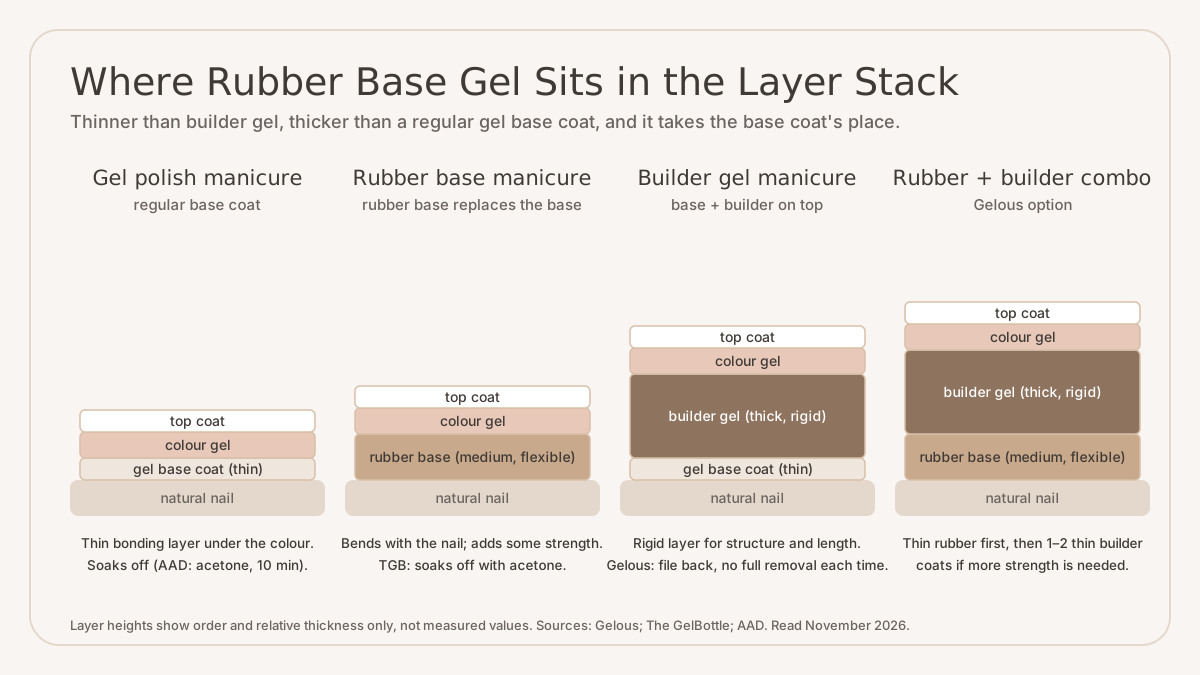
Layer order and relative thickness from Gelous ("thinner than Builder Gel, but thicker than regular Base Coat"; rubber base "replaces your regular Base Coat"; builder is "an additional coat after your Base Coat"), The GelBottle (Rubber Base soaks off with acetone) and the American Academy of Dermatology (gel removal), read November 2026. Layer heights are illustrative, not measured.
Notice that builder gel goes on top of a base, not instead of it, in the Gelous system. Whether your own builder needs a separate base depends on the brand's instructions. The site's builder gel before base coat guide covers that order question and its exceptions in detail.
Flexibility and strength
This is the real trade-off. Gelous puts it plainly: builder gel "offers a super strong, hard finish," but on bendy nails its inflexibility can cause it to "lift, crack or pull away." Rubber base flexes with the nail, but it "doesn't provide the same hardness and rigidity as Builder Gel," which makes it "more prone to general wear over time."
So neither is simply stronger: builder gel is harder, a rubber base gel layer is more forgiving, and which lasts better depends on how much your nails bend.
What each one is for
| Regular gel base coat | Rubber base | Builder gel | |
|---|---|---|---|
| Thickness | Thin | Medium (thicker than base, thinner than builder) | Thick |
| Once cured | Thin bonding layer | Flexible | Hard and rigid |
| Position | Under colour | Replaces the base coat | Over the base, under colour |
| Typical use | Ordinary gel polish manicure | Soft, thin or bendy nails needing flexible support | Nails needing strength, structure or length |
| Can build an apex? | Not its job | Some brands say yes | Yes, its main purpose |
Sources: Gelous, "Builder Gel vs. Rubber Base Coat" (thickness, position, who each suits); Pink Gellac (its Rubber Base "lets you create an apex"), read November 2026.
Length is the clearest dividing line. Gelous recommends builder gel for nails that need "extra strength, support, or structure (especially longer nails)", while rubber base is for "soft, thin or bendy nails that need flexible support." The GelBottle does use rubber base under its file-off BIAB™ extensions, but as the "flexible, strong foundation", with the builder doing the structural work above it. The difference between The GelBottle's BIAB™ and builder gel in general is covered in BIAB vs builder gel.
Removal differences
Removal follows the product, not the name, so always check the label:
- Regular gel base coat: soaks off with acetone, as in the American Academy of Dermatology's home method below.
- Rubber base: The GelBottle says its Rubber Base soaks off with acetone. Pink Gellac lists three ways to remove its Rubber Base: soak off, peel off (if it was applied over a peel-off base), or file off.
- Soak-off builder gel: Gelous notes builder "doesn't need to be fully removed each time"; you file back to the builder layer, smooth it, and apply the next manicure on top. When you do take it all off, more filing is needed before soaking because the layer is thicker.
Which One Should You Use? A Decision Checklist
Work down the lists and stop at the first one that fits your nails and plans. The points apply the manufacturer guidance quoted above; they are not a lab result.
Use rubber base if…
- Your natural nails are soft, thin or bend easily when you press the tip.
- You want to keep your own length and are not adding extensions.
- Gel polish chips or lifts on you, and the nail flexes under it.
- Your nails are flaky, brittle or splitting. The GelBottle says its Rubber Base is "designed to provide added strength and flexibility for flaky, brittle or splitting nails."
- You like a sheer, natural finish and are happy to wear a tinted rubber base on its own.
Use builder gel if…
- You want visible length, or your nails are already long and need structure. Gelous recommends builder for longer nails.
- You are adding extensions with tips or forms.
- You want a shaped apex, the raised stress area that keeps a long nail from snapping.
- Your nails are fairly rigid, so a hard layer will not fight against them.
- You want to fill rather than fully remove at each appointment. Gelous says builder can be filed back and reused as the base for the next set.
The best gel builder base guide compares specific bases for builder systems if you have already settled on builder gel.
Use a regular gel base coat if…
- Your nails are healthy and reasonably strong, and you only want colour.
- Plain gel polish already wears well on you.
- You want the thinnest finish and the simplest removal.
Use both if…
- Your nails are weak and flexible, but you also want extra strength or some length.
Gelous describes this combination: start with a thin layer of rubber base, then add one or two thin coats of builder gel if more strength is needed. For nails that are very weak and flexible, it suggests using only rubber base until they strengthen. That staged approach also fits the advice in builder gel for weak nails: support the nail first, then add rigidity.
How to Apply Rubber Base
Application looks like an ordinary gel manicure with a thicker base. Cure time is what changes most between brands, so follow your own bottle.
Prep the nail
Prep is the same as for any gel system: clean, dry and free of oil. Pink Gellac's instructions start by cleaning the nails with its cleaner on a wipe, then applying its Prep Booster over the whole nail plate and letting it "air dry for 30 seconds." Other brands use a dehydrator or primer at this stage. Leave the cuticles alone: the American Academy of Dermatology's gel manicure tips advise against having cuticles pushed or cut, because it can lead to inflammation and infection.
Before curing anything, the AAD also recommends protecting the skin of your hands from the lamp: a broad-spectrum, water-resistant sunscreen with SPF 30 or higher, or dark, opaque gloves with the fingertips snipped off.
Apply and cure in thin layers
- Wipe off excess on the brush. Rubber base is thicker than a normal base, so a loaded brush floods the cuticle easily.
- Apply a thin, even layer over the whole nail, keeping it off the skin. The FDA's nail care products page says it is important to avoid skin contact "to minimize the chance of an allergic reaction."
- Cap the free edge by running the brush lightly along the tip.
- Cure for the time on your bottle. Brands differ: Pink Gellac gives 60 seconds under an LED lamp for each layer of its Rubber Base, while The GelBottle gives 99 seconds on low heat mode for its Rubber Base. There is no universal cure time.
- Add a second layer if you want more support. Pink Gellac says multiple layers can be applied, each cured on its own; it also says its Rubber Base "lets you create an apex", which in practice means a slightly thicker layer in the centre of the nail.
Finish with colour and top coat
If you used a clear rubber base, apply colour gel next, then a top coat. If you are wearing a tinted or 2-in-1 rubber base, go straight to the top coat. Pink Gellac's steps end with its top coat, cured, and the sticky layer wiped off with a cleaner wipe. Your top coat may be no-wipe instead; check its label.
How to Remove Rubber Base, and When to Stop
Most rubber bases soak off, so home removal is the acetone method used for gel polish, unless the brand says otherwise or hard gel sits on top.
The soak-off method
The American Academy of Dermatology publishes a step-by-step guide to removing gel polish at home:
- Apply a thin layer of petroleum jelly to each cuticle and the surrounding skin to protect it from the acetone.
- Cut cotton to the size of each nail and soak each piece in acetone.
- Place the cotton on the nail and wrap it with plastic food wrap, sealed snugly but not tight enough to cut off circulation.
- Leave it for 10 minutes. The AAD says most or all of the gel should be gone when you unwrap.
- Gently rub off what is left with a washcloth run under warm water, touching only the nail, not the skin.
- Wash with gentle soap and water to remove the acetone, then rub petroleum jelly into the cuticles and surrounding skin every day for seven days.
The AAD's steps are written for gel polish. A rubber base layer is thicker, so if it has not softened after the wrap, re-wrap and wait rather than levering it off. Do not scrape: the AAD warns that "picking or filing off gel nail polish can significantly damage your nails." For a fuller walk-through with builder-thickness layers, see how to soak off builder gel at home.
Read next
How to Soak Off Builder Gel at Home: The 35-Minute Method That Won't Wreck Your Nails
How to soak off builder gel at home without trashing your natural nails — the 35-minute acetone foil method, step by step, with no e-file needed.
Continue readingWhen rubber base sits under hard gel
Rubber base is often used as the soak-off foundation under a file-off product. The GelBottle's help page for its GelPot hard gel says it is "a file-off only hard gel": you "de-bulk down to the Rubber Base layer and then soak off the Rubber Base remaining with 100% acetone." In other words, the rubber base is the layer that makes the last part of removal gentle. File the hard layer down until you reach it, then switch to the soak method above. The site's how to remove hard gel guide explains the filing stage.
Skin reactions and when to see a doctor
The usual gel skin cautions apply. The FDA notes that traces of reactive monomers in artificial nail products "could result in an adverse reaction." If the skin around your nails turns red, itchy or blistered after a manicure, stop using the product, see a doctor, and report the reaction to the FDA as its page asks. Note too that nail products do not need FDA approval before they go on sale, so a bottle labelled "rubber base" has not been approved as safer than any other gel.
Between sets, the AAD suggests going without polish for one to two weeks or longer and applying a moisturizer such as petroleum jelly to the nails and cuticles several times a day.
The short version
Rubber base gel is a flexible base coat with extra body. It replaces your regular base, bends with soft or thin nails, and soaks off like gel polish. Builder gel is thicker and harder and goes over a base to add structure and length. If your nails bend, start with rubber base; if you want length or a firm apex, choose builder gel; if you need both, follow Gelous's suggestion of a thin rubber base under thin builder coats. Whatever you pick, take the cure time and removal method from your own bottle, not from a general rule.
Last updated November 2026. This article is researched with AI assistance and edited before publication; it draws on manufacturer instructions and the sources cited on this page.