| Brand and product | How long does builder gel last, per the brand | Where the brand says it |
|---|---|---|
| Glitterbels builder gel | "typically last between two to four weeks, depending on individual nail growth and lifestyle" | Glitterbels blog, 16 May 2025 |
| Beetles Builder Gel | "can last 3-4 weeks before needing a fill or removal"; also "30+ days without chipping or lifting" | Beetles Nail Academy |
| BTArtboxnails French Protection Set (gel glue, builder gel, top coat) | "Long Lasting 30+ Days" | Amazon listing title, via the Amazon Creators API, 7 Nov 2026 |
| The GelBottle Hard BIAB™ (file-off) | "a file-off formula built to last 4+ weeks" | The GelBottle starter kit page |
| The GelBottle BIAB™ (colour range) | "Long-lasting wear for up to 5 weeks" | The GelBottle blog, 28 Oct 2024 |
Each row quotes the brand's own page or listing, read 13 November 2026 unless dated otherwise. These are manufacturer claims, not independent wear tests.
How long does builder gel last? Builder gel brands say a set lasts about two to five weeks, and most put the practical limit at three to four weeks, when nail growth leaves a gap at the cuticle and the set needs a fill or removal. Your own result depends mostly on prep, cure and how hard your hands work, not on the bottle.
Nobody publishes an industry-wide average wear time for builder gel. The numbers above are what each company states about its own product, which is why they are shown side by side rather than averaged. The rest of this page explains what limits a set in practice: nail growth, which you cannot change, and lifting, which you mostly can. For the full system, start with the site's guide to builder gel nails.
What the Brand Numbers Actually Measure
The five claims above look like they disagree, but they describe slightly different things.
- "Before needing a fill or removal" (Beetles) is the most useful framing. It admits the set does not fail on a set date; it reaches a point where the regrowth gap and the shifted apex make maintenance sensible.
- "Without chipping or lifting" and "long lasting" describe adhesion: how long the gel stays stuck and intact. A set can still be bonded at week five and yet look grown out.
- "Up to" and "+" are ceilings and floors, not typical results. "Up to 5 weeks" means five is the best case. "4+ weeks" means four is where the brand starts counting.
- "Depending on individual nail growth and lifestyle" (Glitterbels) and The GelBottle's note that "retention can vary depending on nail type and individual variables" are the honest caveats every claim carries.
So when a brand says three weeks and another says five, the gap is mostly framing. None of the pages checked publish a test method, sample size or failure definition, so none of the figures can be compared as measurements.
Nail Growth Sets the Clock
The single factor every builder gel set shares is that the nail keeps growing underneath it. The Cleveland Clinic states that fingernails "typically grow about 3 millimeters per month." The gel is bonded to the plate, so it travels toward the tip with the nail, and bare new nail appears at the cuticle. Builder gel protects the length you grow; it does not speed growth up, as the site's page on builder gel for nail growth explains.
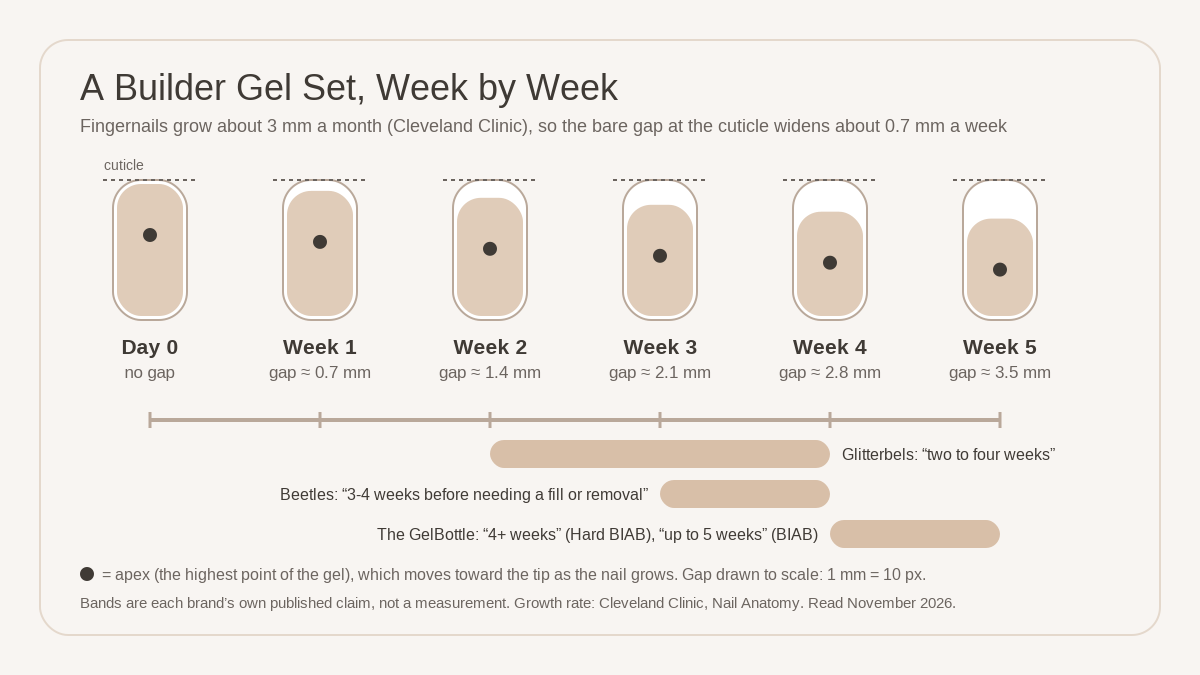
Diagram produced for this page. Growth rate: Cleveland Clinic, "Nail Anatomy"; brand bands: Glitterbels, Beetles and The GelBottle pages linked above. Read November 2026.
Regrowth gap by week
At 3 mm a month (about 36 mm a year, or roughly 0.7 mm a week), the arithmetic looks like this:
| Time since application | Approximate bare gap at the cuticle | What that usually means |
|---|---|---|
| Week 1 | about 0.7 mm | Barely visible; nothing to do |
| Week 2 | about 1.4 mm | Visible on dark or opaque colours |
| Week 3 | about 2.1 mm | Inside the 2–3 mm range the site's fill guide treats as fill time |
| Week 4 | about 2.8 mm | Top of that range; Beetles' 3–4 week mark ends here |
| Week 5 | about 3.5 mm | Past it; The GelBottle's "up to 5 weeks" ceiling |
Calculated from the Cleveland Clinic's 3 mm per month (12 months ÷ 52 weeks). Individual growth rates differ, so treat each row as an estimate.
Why the gap matters more than the look
The gap is cosmetic at first. The structural problem is the apex, the thickest point of the gel, which is built over the stress area of the nail. As the nail grows, the apex rides forward toward the free edge. The further out it sits, the more leverage any knock on the tip puts on the bond near the cuticle. That is one reason a grown-out set is more likely to lift or crack than a fresh one. The site's builder gel apex placement guide shows where the apex belongs and why.
Fill or Remove: Reading Your Set
Most builder gel can be maintained with a fill instead of a full redo, which is a large part of its appeal.
A fill makes sense when:
- The regrowth gap is around 2–3 mm
- The gel is still bonded everywhere else
- There are no cracks running past the apex
Remove and start over when:
- More than one nail is lifting
- You can feel a hollow when you tap the nail (the gel has separated)
- The set has gone well past four weeks and the old bond is suspect
Those thresholds come from the site's step-by-step guide on how to fill builder gel, which walks through the file-down, prep and rebuild. The removal method depends on the product: The GelBottle's original BIAB™ colours state "Soak-off to remove," while its Hard BIAB™ is listed as file-off. Check your own bottle before you reach for acetone.
The American Academy of Dermatology also suggests a pause between gel manicures. In its gel manicure tips it advises: "Try not to wear nail polish for one to two weeks or longer." Rolling fills are convenient, but the AAD's guidance is a reason to give nails a gap between sets now and then.
What Shortens Wear
When a set fails well before the brand's figure, the cause is usually one of a short list. The brand sources and the AAD agree on most of it.
| Cause | Who says so | What it does | Where to fix it |
|---|---|---|---|
| Oil, moisture or dead cuticle left on the plate | Beetles | "will create a barrier that causes lifting" | How to prep nails for builder gel |
| Gel touching skin or cuticle | Beetles | "will cause lifting" because gel cannot bond to skin | Prep guide, cuticle steps |
| Thick gel at the cuticle line; thick base coat | Beetles | Thick base "can shrink during curing, pulling away from the edges" | Apex guide above |
| Thick, gloopy application | Glitterbels | "uneven curing, leading to weak spots and potential lifting" | How long to cure builder gel |
| Water and harsh chemicals | Glitterbels; AAD | AAD: "Too much water exposure can weaken your nails" | Gloves for wet work (below) |
| Using nails as tools | Glitterbels; AAD | AAD: can cause "chipping, splitting, or lifting of the nail bed" | Habits list below |
| Dry cuticles and nails | Beetles; Glitterbels | Manicure may "lift faster"; "cracking or lifting" | Cuticle oil |
| Picking at a lifted edge | Glitterbels; AAD | Damages the natural nail; AAD: "don't pick at the polish" | Fill or remove instead |
Sources: Beetles Nail Academy, Glitterbels blog, AAD "11 dermatologists' tips for healthy nails" and "Gel manicures", read 13 November 2026.
Curing deserves a special mention because it is easy to get wrong without noticing. Beetles, for example, gives different times for LED and UV lamps (60 seconds per building layer under LED, 2 minutes under UV), and other brands print their own. Cure time is set per brand and per lamp, never universally, and the cure guide linked in the table covers how to read the label.
Read next
Builder Gel Lifting? When It Lifts Tells You Why It's Lifting (2026)
When your builder gel lifts tells you exactly what went wrong. Day 1-3 means prep failed. Day 4-7 means cure failed. Day 8+ usually means impact or natural regrowth.
Continue readingIf a set is already lifting, the timing of the lift says a lot about the cause. The builder gel lifting fixes page sorts lifts by the day they appear: an early lift points to prep, a mid-set lift to cure or placement, and a late lift is often just regrowth.
Habits That Help a Set Reach the Brand's Number
None of these are exotic. They are the habits the brands and the AAD name, in one place.
- Wear gloves for wet work. The AAD's nail tips say to "wear gloves when cleaning or washing dishes."
- Keep nails clean and dry between washes, also from the AAD list.
- Do not use nails as tools. The AAD's example is opening pop cans. Use the pad of the finger or a tool instead.
- Oil the cuticles. Both Beetles and Glitterbels link dry cuticles to faster lifting.
- Leave the cuticle alone. The AAD says never to let a manicurist "push or cut your cuticle," because of the risk of inflammation and infection.
- Book the fill before the problem. On the growth arithmetic above, three to four weeks is when the gap reaches 2–3 mm for a typical nail.
- Do not pick. A lifted corner is a signal to fill or remove, not to peel.
An Illustrative Timeline
This is a worked example, not a record of a real person's set. Every number comes from the sources above.
Take an illustrative set applied on the 1st of a month to nails growing at the Cleveland Clinic's typical 3 mm a month, with good prep and full cures.
- Day 1 to 14: about 1.4 mm of new nail appears at the cuticle. On a sheer nude this is hard to see; on red it shows.
- Day 21: about 2.1 mm of gap. This is the earliest point the site's fill guide would treat as fill time, and the start of Beetles' 3–4 week window.
- Day 28: about 2.8 mm. The apex has moved forward by the same distance. A fill now keeps the structure where it should be.
- Day 35: about 3.5 mm, the end of The GelBottle's "up to 5 weeks". A set that is still bonded can be filled, but the old bond near the old cuticle line deserves a close look.
Now change one input. If the same nails grow faster than average, every date arrives earlier; if they grow slower, later. That is why Glitterbels ties its range to "individual nail growth", and why the most reliable schedule is to check your own gap at week three rather than to count days.
Shelf Life of an Opened Bottle
None of the manufacturer pages checked for this article (Beetles, The GelBottle, Glitterbels) state a shelf life or a use-by period after opening. Rather than repeat a figure nobody published, the practical advice is to look at the bottle and its box for a period-after-opening symbol or a printed date, and to follow the brand's own storage instructions.
Frequently Asked Questions
How long does builder gel last on natural nails without a fill?
The brands checked put it at two to five weeks. Beetles says 3–4 weeks before a fill or removal, and The GelBottle's ceiling is "up to 5 weeks". At 3 mm of growth a month the regrowth gap reaches 2–3 mm somewhere in weeks three and four, which is where most sets need attention.
Why did my builder gel only last a week?
A set that fails inside the first week is almost always a prep, cure or application problem rather than the product's wear limit. Beetles names oil or moisture on the plate, gel on the skin and thick gel at the cuticle as lifting causes; under-curing is another. The lifting and prep guides linked above walk through each one.
Can a builder gel set stay on longer than five weeks?
None of the brands checked claims more than five weeks; The GelBottle's "up to 5 weeks" is the highest figure in the table. By then a typical nail has grown about 3.5 mm under the set, and the apex has moved forward by the same amount. Fill or remove it, and remember the AAD's suggestion to go "one to two weeks or longer" without polish between gel manicures now and then.
Last updated November 2026. This article is researched with AI assistance and edited before publication; it draws on manufacturer instructions and the sources cited on this page.