Polygel vs Gel-X vs builder gel is the question I get most often from DIY users trying to pick a single nail enhancement system. The three systems look superficially similar — all three end with cured-under-LED, soft-gel-family nails — but they solve completely different problems, and the wrong choice means six weeks of regret. This guide is the full 3-way breakdown by application speed, durability, cost, removal, and skill curve.
The 60-Second Summary
Polygel vs Gel-X vs builder gel are three different solutions to the same goal — extending and reinforcing natural nails. They are NOT interchangeable. Each one wins in specific situations:
- Builder gel wins for overlays, natural-nail strengthening, and budget-conscious DIY
- Gel-X wins for fast, uniform-length sets and clients who switch styles every 2 weeks
- Polygel wins for custom-shape extensions, lightweight feel, and intermediate skill level
If you pick the wrong system for your situation, you will dislike whatever you bought. Match the system to your goal, not the marketing.
One Pick Per System
The three systems, the three Amazon-stocked starters
The builder gel I recommend most often, the Aprés Gel-X system that defined soft-gel tips, and a beginner-friendly polygel kit. Compare directly.

Makartt Hema-Free Poly Nail Gel Clear 50ML Gel Builder for Natural-Looking Strengthener 3D Molding Gel for Trendy Nail Art Long-Lasting and Easy to Use for Home Salon
$9.99
Amazon price as of Sep 30, 2026

modelones Builder Nail Gel, 7-in-One Clear Builder for Nails, LED Lamp Cured Color Rubber Base Gel Polish Coat Strengthener Thickening Extension Rhinestone Glue in a Bottle for DIY Home Salon Gifts
$8.48
Amazon price as of Sep 30, 2026

Beetles Solid Builder Gel for Nails,4 Colors Clear Pink White 3D Sculpting Gel Non-Sticky Hand Carving Nail Glue for 3D Nail Art with 3D Mold Chrome Powder Tools Salon DIY at Home,UV&LED Needed
$30.99
Amazon price as of Sep 30, 2026
Scroll →
Product prices and availability are accurate as of Sep 30, 2026 and are subject to change.
What Each System Actually Is
Builder Gel
Builder gel is a thick, self-leveling soft gel applied directly to the natural nail. You build structure by placing a bead, shaping it with a brush, and curing under LED. The "apex" — the structural high point of the gel — is the critical skill. Soak-off in acetone for removal.
Most associated with: brands like Modelones, Beetles, The GelBottle, OPI.
Gel-X
Gel-X is a pre-formed soft-gel tip system. Pre-shaped tips (11+ sizes per shape) are glued onto the natural nail using a special adhesive gel (Aprés Extend Gel or builder gel), cured, then trimmed and filed. No sculpting — the shape is built into the tip.
Most associated with: Aprés (originator), Makartt, and various dupe brands.
Polygel
Polygel is a hybrid material — thicker than gel, more pliable than acrylic. You pinch a small amount from a tube, place it on the nail or extension form, shape it with a brush and alcohol slip solution, then cure. Functions like sculpted acrylic but uses LED instead of monomer liquid.
Most associated with: Makartt, Modelones, Kiara Sky.
Side-by-Side Comparison Table
| Factor | Builder Gel | Gel-X | Polygel |
|---|---|---|---|
| Form | Self-leveling liquid gel | Pre-formed plastic tips | Pliable putty in tube |
| Application time (full set) | 60-90 min | 30-45 min | 60-90 min |
| Skill required | Beginner-Intermediate | Beginner | Intermediate |
| Wear time | 14-21 days | 14-21 days | 14-21 days |
| Best for length | Short to medium | Any length | Any length |
| Lamp needed | LED 48W+ | LED 48W+ | LED 48W+ |
| Sculpting needed? | Yes (apex) | No | Yes |
| Forms or tips? | Optional | Tips required | Forms required |
| Removal | Soak-off 25-30 min | Soak-off 25-30 min | E-file + soak |
| Cost per set | $1-2 (after kit) | $2-3 per tip set | $1.50-2.50 |
| Initial kit cost | $20-50 | $50-100 | $30-60 |
| Air bubbles | Rare | Rare | Common if technique poor |
| Self-leveling | Yes | N/A | No |
| HEMA-free options | Yes | Limited | Rare |
| Natural nail damage risk | Low (with proper removal) | Low | Medium (often needs e-file) |
| Visible at the cuticle line | Subtle | Tip seam visible | Subtle |
| Salon-pro adoption | High | Very high | Moderate |
| Best for sensitive nails | Yes | Yes | No |
Use Case 1 — Fast, Uniform-Length Sets
Goal: "I want 10 long nails done as fast as possible, all the same shape."
Winner: Gel-X. This is the situation Gel-X was designed for. Pre-formed tips mean every nail has the same length and shape inherently. A trained applicator does a full set in 30-45 minutes. Builder gel and polygel both require sculpting each nail individually, which adds 30-60 minutes minimum and varies the result.
For consistent length: Gel-X every time.
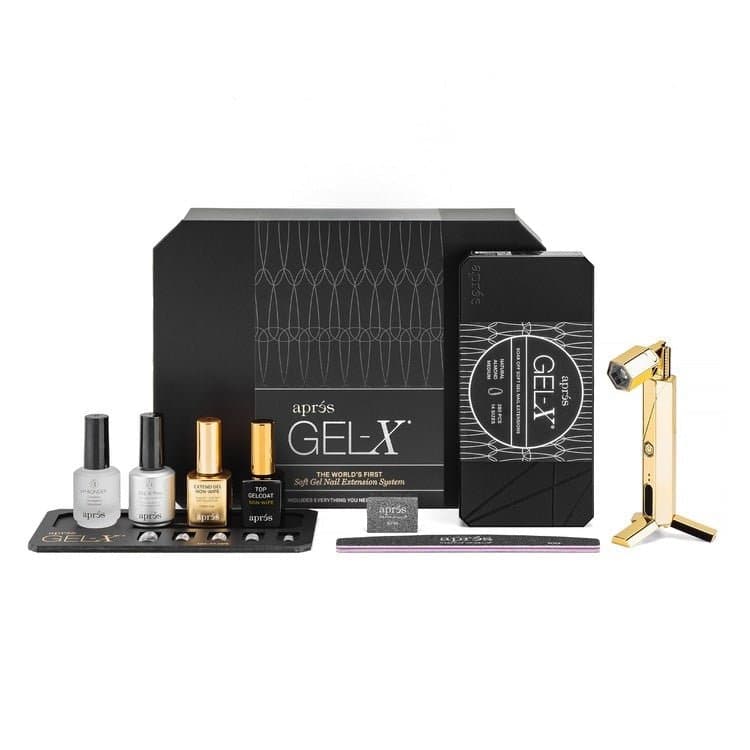
Aprés Gel-X Signature Kit
$50–$120
Also on Amazon
Beetles Hard Gel for Nails Kit (3 Colors)
$29.99★ 4.4
For deeper Gel-X coverage, see builder gel vs Gel-X.
Use Case 2 — Strengthening Natural Nails Without Length
Goal: "I want my own nails to be stronger and longer-lasting, no added length."
Winner: Builder gel. This is what builder gel is best at. Apply a thin overlay directly to the natural nail, build a small apex for stress support, top coat. No tip, no sculpting beyond the apex. Gel-X requires tips (adds length you do not want); polygel is overkill for thin overlays.

Modelones Builder Nail Gel 3-Pack with Top Coat
$13.99
Amazon price as of Sep 30, 2026
For natural-nail-only context, see builder gel on natural nails.
Read next
Builder Gel on Natural Nails: The Strengthen-and-Protect Guide (2026)
Builder gel is the gentlest enhancement option for weak, peeling, or recovering natural nails. Here's exactly when to use it, how to apply it differently than for extensions, and the recovery schedule that prevents long-term thinning.
Continue readingUse Case 3 — Custom-Shape Extensions (Stiletto, Coffin, Ballerina)
Goal: "I want sculpted stiletto or coffin extensions that look custom-formed."
Winner: Polygel (or sculpted builder gel for experienced users). Pre-formed Gel-X tips do come in shapes, but the sculpting precision of polygel — or experienced-user builder gel — produces more dramatic, custom-tailored results. Polygel's thick consistency lets you sculpt aggressively without flooding cuticles.
Polygel is the sweet spot here because it does not require liquid monomer (acrylic) and cures faster than acrylic, but gives sculptability that Gel-X tips cannot.
Use Case 4 — Beginner DIY at Home
Goal: "I am new to nails and want to do my own at home."
Winner: Builder gel (if natural-nail focused) or Gel-X (if wanting length immediately).
Polygel is the wrong starting point for most beginners. The pinch-and-shape technique has a steep learning curve. Most beginners spend 3-5 sets building basic competence, vs 2-3 sets for builder gel and 1-2 sets for Gel-X.
If your priority is "I want my own nails to look better starting today," Gel-X is the fastest path to a confidence-boosting result. If your priority is "I want to learn a system and stick with it," builder gel has the longest skill ceiling.
For beginner roadmap context, see best builder gel for beginners.
Use Case 5 — Cost Per Year
Goal: "Which is cheapest if I am doing this regularly?"
Winner: Builder gel.
Year-1 math for 17 sets per year (every 3 weeks):
- Builder gel: $30 kit + $30/year refill = $60/year, or $3.50/set after kit
- Gel-X: $80 kit + $30/year tips refill + $20 extend gel = $130/year, or $7.65/set
- Polygel: $40 kit + $25/year polygel refill = $65/year, or $3.82/set
Builder gel and polygel are similar on yearly cost. Gel-X is roughly 2x because tips are consumable per set.
Use Case 6 — Sensitive Skin or HEMA-Free Need
Goal: "I have acrylate sensitivity or want to minimize HEMA exposure."
Winner: Builder gel. Multiple HEMA-free builder gel options exist (Beetles HEMA-Free 8-in-1, The GelBottle Au Lait). Gel-X has very limited HEMA-free options. Polygel HEMA-free is rare.

Beetles Builder Gel Nails Kit HEMA-Free 8-in-1
$21.99
Amazon price as of Sep 30, 2026
For sensitivity-aware buyers, builder gel is the only system with a meaningful HEMA-free product ecosystem.
The American Academy of Dermatology covers acrylate contact dermatitis in detail. HEMA exposure is the main sensitization pathway in nail enhancements.
Use Case 7 — Salon-Pro Use
Goal: "I am a licensed nail tech building my product stack."
Winner: All three (pick by client mix).
Salon-pro use is the only context where buying all three systems makes sense. Different clients want different things:
- Builder gel for overlay clients
- Gel-X for fast-set clients
- Polygel for custom-shape clients
For multi-system salons, see the best builder gel brands guide for the pro-tier options across all three systems.
Use Case 8 — Soak-Off Reversibility
Goal: "I want to be able to remove this without damaging my natural nails."
Winner: Builder gel (followed closely by Gel-X). Both are soak-off in 25-30 minutes. Polygel often requires e-file work for full removal — the thicker layer resists pure acetone soak-off. For DIY users without an e-file, polygel removal is harder.
For full removal protocol on builder gel, see how to remove builder gel. For e-file-free options, see how to remove builder gel without drill.
Use Case 9 — Air Bubbles and Application Defects
Goal: "I do not want to deal with air bubbles ruining a set."
Winner: Builder gel (least bubble-prone). Self-leveling builder gel rarely traps air. Gel-X bubbles only when tip placement is misaligned. Polygel is bubble-prone — the pinch-and-shape technique introduces air pockets unless your slip solution and brush pressure are dialed in.
If you have done one polygel set and watched air bubbles appear under cure — you know the frustration.
Use Case 10 — Shape Customization
Goal: "I want a specific custom shape my regular tips cannot make."
Winner: Polygel (for full sculpted custom shapes) or builder gel (for moderate customization with paper forms).
Polygel gives the most freeform sculpting because of its thick pliable consistency. Builder gel can do custom shapes with paper forms but lacks polygel's sculpting precision. Gel-X is locked into the manufacturer's tip shapes.
Which Should YOU Pick?
The decision tree:
- Do you want length immediately, no learning curve? → Gel-X
- Do you want to strengthen natural nails only? → Builder gel
- Do you want custom sculpted shapes? → Polygel
- Are you DIY-budget-focused? → Builder gel
- Do you have HEMA sensitivity? → Builder gel (HEMA-free SKUs available)
- Are you a salon pro? → Pick by client mix — start with builder gel
- Do you do nails every 6+ weeks (very occasional)? → Gel-X (simpler)
- Do you do nails every 2-3 weeks? → Builder gel (best long-term economics)
Most readers of this site land on builder gel — which is why this site is called BuilderGelNails.com. But the right pick depends on your specific goal.
What If You Try All Three?
Realistic outcome for most DIY users who try all three over 6 months:
- Builder gel becomes the daily-driver system (most use cases, best cost)
- Gel-X becomes the "going out / fast" system (when speed matters)
- Polygel typically gets abandoned within 5-10 sets (skill curve too steep for occasional users)
Pros use all three. Most DIY users settle into 1-2 systems.
Frequently Asked Questions
Which is stronger — polygel, Gel-X, or builder gel? Polygel is structurally the strongest (acrylic-like density). Builder gel is medium-strength but more flexible. Gel-X is medium-strength with the tip providing length-specific reinforcement. For long extensions (5mm+ past free edge), polygel wins on raw strength.
Which lasts longest — polygel, Gel-X, or builder gel? Wear time averages 14-21 days for all three when properly applied. The system does not determine wear time as much as prep + apex + free-edge cap + maintenance do. Properly done, all three give 21-day sets.
Which is best for beginners? Gel-X for "I want length fast." Builder gel for "I want to learn." Polygel is the hardest of the three to start with.
Can I mix the three systems in one set? Yes — and pros sometimes do. Builder gel + Gel-X tips is a common pro combo (builder gel as the adhesive). Polygel on top of builder gel is less common. Mixing all three in one nail is rare and unnecessary.
Which gives the most natural-looking nails? Builder gel — particularly for overlays without added length. Polygel can look natural but requires expert shaping. Gel-X always has a slight visible seam at the free-edge transition.
Which is least damaging to natural nails? All three are equally safe IF removed properly. Damage comes from improper removal (peeling, e-file abuse), not from the system itself. Builder gel and Gel-X are easiest to soak off; polygel often needs e-file work which raises damage risk for amateur users.
Cross-References
For pairwise comparisons:
- Builder gel vs polygel
- Builder gel vs Gel-X
- Builder gel vs acrylic (acrylic is the older counterpart system)
- Builder gel vs dip powder (dip is the no-cure system)
For wider context: the Builder Gel Atlas pillar guide explains where builder gel fits in the broader soft-gel category, and the best builder gel kits guide covers specific kit picks.
Final Notes from Sara
The "best" system is a meaningless question. The right question is "which system fits the use case I have today." Gel-X for speed. Builder gel for everyday durability and natural-nail health. Polygel for custom shapes.
Most DIY readers should start with builder gel because the skill curve is moderate, the cost is lowest, and the system has the broadest use-case coverage. From there, add Gel-X if you find yourself wanting faster sets, and add polygel only if you want custom shapes.
Do not buy all three at once. Pick the one that solves your biggest current frustration, learn it, then add the next.
Last updated May 2026. This article uses AI assistance for research and structure; all comparisons come from my own salon practice across the three systems, plus at-home testing of consumer kits.