A structured gel manicure is a gel manicure with builder gel added to give the natural nail a shape: thin at the cuticle, thickest at a raised point called the apex, and thin again at the tip. The apex sits over the stress area, where the nail bends, so the nail is reinforced where it would otherwise flex and break. Colour usually goes on top, and the set is rebalanced every few weeks rather than replaced.
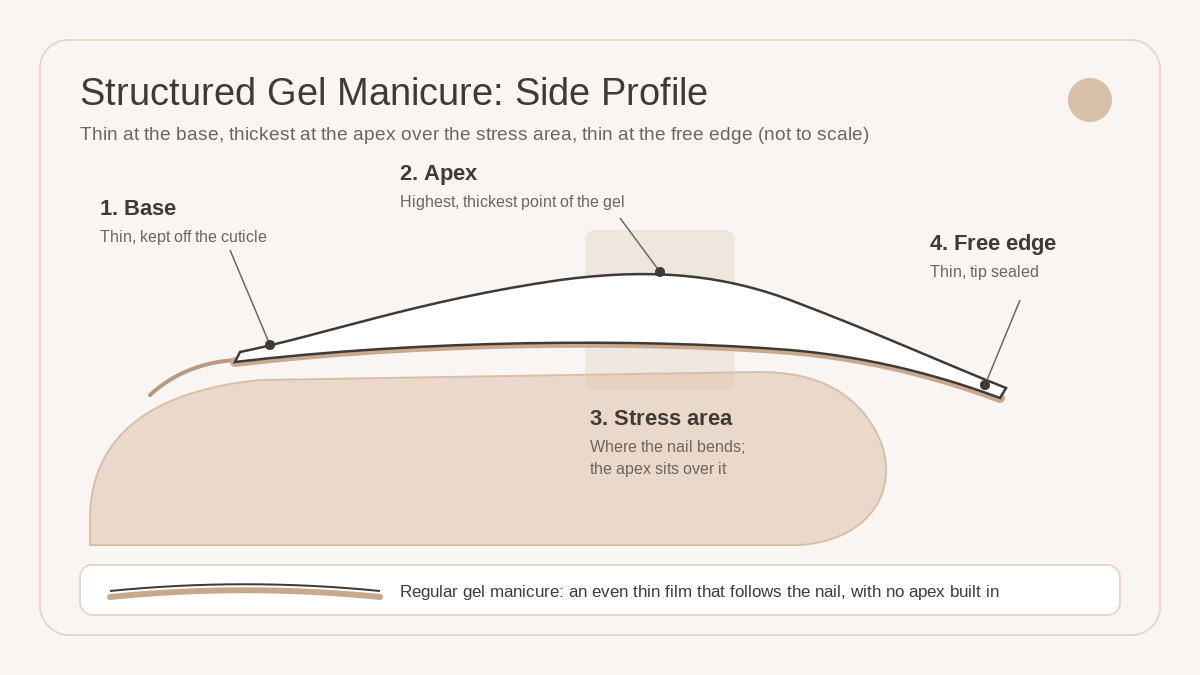
Diagram: the four zones of a structured nail, drawn from the application instructions of Nitro Nails ("keeping the cuticle area thin and placing the apex in the stress area") and The GelBottle ("create an apex with a second BIAB layer"), read November 2026. Not to scale.
"Structured" describes the shape the technician builds, not a special product: the same builder gels sold for overlays and extensions are used. Below are the appointment, a comparison with regular gel, and a numbered home method with every cure time attributed to the manufacturer that printed it.
What Makes a Manicure "Structured"
A regular gel manicure is a thin coating: base, colour and top coat brushed on in even layers that follow the natural nail's curve.
A structured manicure adds a layer of builder gel, a thicker gel designed to hold a shape before it is cured. The technician uses it to build an arch along the length of the nail. Nitro Nails, a builder gel maker, describes that step in its builder gel instructions as floating "a bead of gel to build structure, keeping the cuticle area thin and placing the apex in the stress area."
Three things follow from that one sentence:
- There is a deliberate high point. The apex is the thickest part of the gel, so it is the part that resists bending.
- The thickness is uneven on purpose. Thin at the cuticle (so it blends into the nail), thick in the middle, thin at the free edge.
- Placement depends on the nail. The stress area is found on each nail, not at a fixed distance. The site's builder gel apex placement guide covers how the position shifts with nail shape and length.
The Four Zones of a Structured Nail
The diagram above splits a structured nail into four zones.
1. Base. The area nearest the cuticle. The gel here should be thin and kept off the skin. Nitro Nails tells users to keep "the cuticle area thin", and the FDA notes that "it is important to avoid contact with the skin" to minimise the chance of an allergic reaction to nail products.
2. Apex. The highest point of the curve when the nail is viewed from the side. It is the reason the service exists: a thicker arch is stiffer than a flat film of the same gel.
3. Stress area. Not a layer but a location: the part of the nail that bends when the tip is pushed. The apex sits over it. If the apex lands too far towards the cuticle or too far towards the tip, the thin parts of the nail take the load instead.
4. Free edge. The tip. Gel here is thin again so the nail does not look blunt, and the edge is sealed (capped) so the layers are less likely to separate from the front.
Structured vs Regular Gel Manicure
The two services share prep, curing and top coat.
| Regular gel manicure | Structured gel manicure | |
|---|---|---|
| Middle layer | Thin gel colour only | Builder gel shaped into an apex, colour on top or tinted builder alone |
| Shape from the side | Even film following the natural nail | Thin at base, thick at apex, thin at free edge |
| Purpose | Colour and shine | Colour plus reinforcement of the natural nail |
| Maintenance | Removed and redone | Rebalanced: Nitro Nails says to rebalance "every 2–3 weeks" by thinning the old gel and rebuilding the apex |
| Removal | Acetone soak; the AAD gives 10 minutes for gel polish | Builder gel is filed down much further before soaking (Essie); hard gel is filed off only |
| Can it add length? | No | Not by itself; an extension is a separate build on a form or tip |
Sources: Nitro Nails builder gel instructions; AAD, "Removing gel polish at home"; Essie, "How to remove gel nail polish at home"; all read November 2026.
There is no wear-time row because no independent body publishes average wear for either service.
For a closer look at a natural-nail build without colour, see the builder gel overlay guide, which covers overlay thickness and how an overlay differs from an extension.
Structured Gel, Builder in a Bottle and BIAB™: Names, Not Different Services
Salon menus use several names for the same service: structured manicure, structure gel manicure, builder gel manicure, gel overlay, and BIAB.
- "Structure gel" is a product description. Several brands use it for a builder gel thick enough to hold an apex.
- "Builder in a bottle" is a format: builder gel in a polish-style bottle with a brush, rather than in a jar.
- BIAB™ is a trademark of The GelBottle. Its own application guide describes a structured build without using the word: a thin first layer, then "create an apex with a second BIAB layer", with an optional third layer "for sheer colors, fuller coverage, or longer nail extensions."
Whatever the menu calls it, ask which product is used and whether it soaks off. The BIAB vs builder gel comparison goes through the format and formula differences in detail.
What Happens at a Structured Gel Manicure Appointment
Salons vary, but the sequence follows the manufacturer steps. An illustrative appointment:
Consultation and removal. If you arrive with an old set, it is either removed or rebalanced. A rebalance (sometimes called an infill) keeps the old structure, thins it, and fills the regrowth gap at the cuticle.
Prep. The technician shapes the nail, lightly buffs the surface so gel can grip, cleans off dust, and applies a dehydrator and primer. Nitro Nails also lists pushing back cuticles and removing "non-living tissue" from the nail plate. The American Academy of Dermatology is firmer: "never let your manicurist push or cut your cuticle, as this could lead to inflammation and infection." It is reasonable to ask for the cuticle to be left alone.
Base and build. A thin first layer of builder gel goes on, then a bead is floated over the nail to form the apex. Nitro Nails' instructions include briefly turning the finger upside down to help the gel self-level before curing, and The GelBottle's guide cures the apex as a separate second layer.
Refine. The cured gel is wiped and filed to balance the shape: smooth sidewalls, a clean free edge, an even arch.
Colour and top coat. Gel colour goes over the structure, or a tinted builder is left as the colour. A top coat seals it and is cured.
UV protection. The AAD recommends applying broad-spectrum sunscreen with SPF 30 or higher to your hands before a gel manicure, or wearing dark, opaque gloves with the fingertips cut off. Bring your own if the salon does not offer either.
Prices and appointment length vary by salon and region, and nobody publishes a reliable national figure, so ask for both when you book, along with whether removal of the old set costs extra.
How Long a Structured Gel Manicure Lasts
No independent body publishes a measured average. What can be said:
- The maker's maintenance interval is the useful number. Nitro Nails tells users to "rebalance every 2–3 weeks by debulking and rebuilding the apex." As the nail grows, the apex moves towards the tip and a gap shows at the base; the rebalance puts the structure back over the stress area.
- Prep is part of the wear. Both manufacturers' instructions put prep first: removing tissue from the nail plate, etching, dehydrating and priming. If a set lifts early, the lifting guide below sorts the patterns by where the lift starts.
Read next
Builder Gel Lifting? When It Lifts Tells You Why It's Lifting (2026)
When your builder gel lifts tells you exactly what went wrong. Day 1-3 means prep failed. Day 4-7 means cure failed. Day 8+ usually means impact or natural regrowth.
Continue readingHow to Do a Structured Gel Manicure at Home
A home structured manicure is realistic with a soak-off builder gel, a matching lamp and patience on the first few nails. The steps below combine two manufacturers' instructions. Cure times are product-specific: use the time printed on your own bottle and lamp, not the examples here.
-
Protect your hands from the lamp. Apply SPF 30+ broad-spectrum sunscreen to the hands, or wear fingertip-less dark gloves, as the AAD advises for gel manicures.
-
Shape and clean the nail. File the free edge to shape. Do not cut the cuticle; the AAD warns that cutting or pushing it can lead to inflammation and infection. Nitro Nails lists removing non-living tissue from the nail plate itself as part of prep.
-
Buff the shine off lightly. Nitro Nails specifies a "180–240 grit file" to etch the surface; The GelBottle lists a 100/180 buffer. Light pressure only: the goal is to remove shine, not thin the nail.
-
Dehydrate and prime. Brush off all dust, apply a dehydrator, then a primer. Nitro Nails says to let an acid-free primer "fully air dry" before any gel goes on.
-
Apply a thin first layer. Brush a thin, even layer of builder gel over the whole nail, keeping it off the skin. Nitro Nails leaves this "slip layer" uncured; The GelBottle cures its first BIAB layer (99 seconds on its own lamp's low-heat mode). Follow the method for the product you bought.
-
Float a bead to build the apex. Pick up a small bead of builder gel and lay it near the middle of the nail, not at the cuticle. Guide it towards the base and the tip with the brush barely touching, so the middle stays thickest. Keep it thin at the cuticle and sidewalls.
-
Turn the finger over, then cure. Nitro Nails says to briefly "turn the finger upside down" to help the gel self-level into an arch. Turn back, check the side profile, and cure: Nitro Nails gives 60 seconds under LED or 120 seconds under UV for its gel; The GelBottle gives 99 seconds on low-heat for each BIAB layer. Work one nail at a time until the shape becomes easy.
-
Wipe and refine. Remove the sticky inhibition layer, then file to balance the shape. The GelBottle refines with a 120/180 file. Look at each nail from the side and from the end: the arch should be smooth, highest over the stress area, and level side to side.
-
Add colour and seal. Apply gel colour over the structure if you want it, then a top coat. The GelBottle cures its top coat for 60 seconds. Afterwards, wash your hands and keep up with moisturiser; the AAD suggests petroleum jelly on nails and cuticles several times daily.
If a first attempt comes out flat or lumpy, the longer how to apply builder gel on natural nails tutorial adds troubleshooting for each stage.
When the rebalance is due, file the old gel down until the structure is thin and even, fill the regrowth area, and rebuild the apex in its new correct position. Nitro Nails calls this "debulking and rebuilding the apex."
Removal, Breaks and Nail Health
Plan removal before the first set, because the method depends on the product.
Soak-off builder gel. Essie's gel removal guide says that with builder or BIAB gel "it's important to file down a lot more of the gel thickness before soaking with acetone." After filing, the AAD's home removal method applies: petroleum jelly on the surrounding skin, acetone-soaked cotton on each nail, plastic food wrap, 10 minutes, then a warm washcloth.
Hard gel. Some structure gels are hard gel, which does not dissolve. Nitro Nails states plainly that its builder in a jar is "file off only" because "hard gel does not soak in acetone", and Essie says hard gels "can only be filed off, preferably by a professional manicurist." Check which type you have before you buy, or ask the salon. The site's builder gel vs hard gel page compares the two.
Never pick. The AAD warns that "picking or filing off gel nail polish can significantly damage your nails", and that gel manicures in general "can cause nail brittleness, peeling and cracking."
Take breaks. The AAD suggests going without polish for one to two weeks or longer between manicures so the nails can recover, and moisturising daily for seven days after removal.
Watch for reactions. Redness, itching or blistering around the nails after a gel service is a reason to see a doctor. The FDA warns that traces of reactive monomers in artificial nail products "could result in an adverse reaction", notes that nail products "do not need FDA approval before they go on the market" and asks people who react to tell their doctor and then the FDA.
Frequently Asked Questions
Is a structured gel manicure the same as BIAB?
In practice, nearly. BIAB™ is The GelBottle's brand of builder gel in a bottle, and its application guide builds an apex just as a structured manicure does. A salon offering a "structured manicure" may use BIAB or another brand of builder gel, and the shape it builds is what defines the service.
Can a structured manicure help nails grow longer?
It can help nails that bend and break at the tip reach a longer length, because the apex stiffens the nail where it would otherwise flex. It does not make the nail grow faster, and no source on this page claims that it does.
Can you do a structured gel manicure on short nails?
Yes. Nothing in the manufacturer instructions on this page requires length: the same thin-thick-thin profile is built over a shorter nail, with the apex still placed over that nail's own stress area. Keeping the base thin and the gel off the skin matters just as much as on a long nail.
How do you take off a structured manicure without damaging your nails?
File most of the builder gel thickness off first (Essie), then soak the thin remainder using the AAD's acetone-and-wrap method, and never pry or peel. If the product is hard gel, it has to be filed off completely, ideally by a professional. For every other guide on the site, start at the builder gel nails homepage.
Last updated November 2026. This article is researched with AI assistance and edited before publication; it draws on manufacturer instructions and the sources cited on this page.